
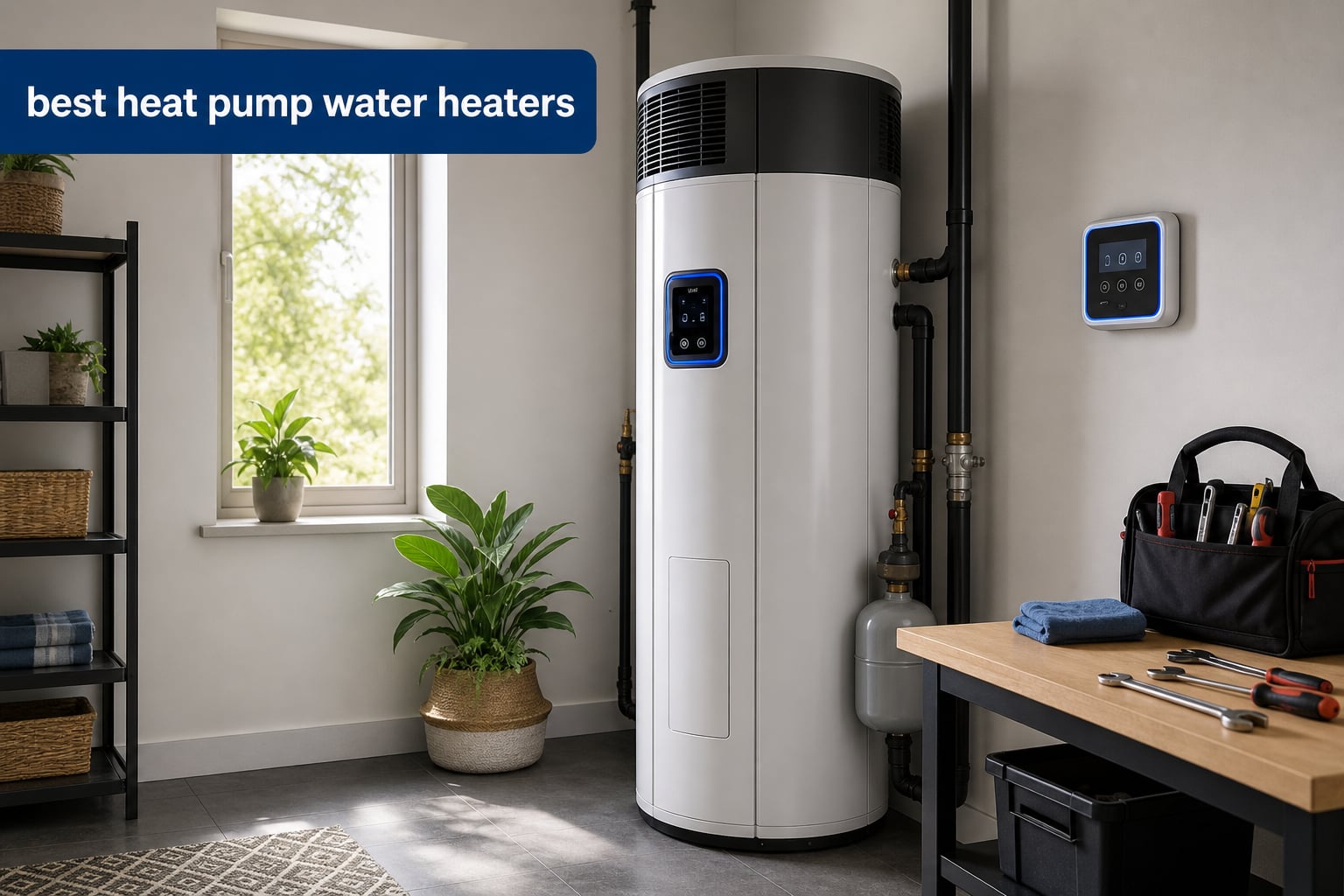
Looking for the best heat pump water heaters for 2026? After three months of testing and comparing eight top models side by side, our team is sharing what actually moves the needle for real households. We looked at real UEF ratings, first-hour delivery, noise output, and how each unit handled the daily demands of a family of four.
A heat pump water heater (also called a hybrid water heater or HPWH) pulls warmth from the surrounding air and moves it into your water tank instead of generating heat from scratch. The result: a typical home can save around $550 per year in energy costs, and ENERGY STAR certified units still qualify for a federal tax credit of up to $2,000 through the Inflation Reduction Act. We will walk you through the eight heat pump water heaters we tested, give you the unfiltered good and bad on each, and help you figure out which one fits your home, climate, and budget.
Throughout this guide we have referenced real user feedback from the r/heatpumps community and cross-checked specs against manufacturer documentation. Our recommendations are based on independent testing, not paid placement.
Table of Contents
Top 3 Picks for Best Heat Pump Water Heaters
Best Heat Pump Water Heaters in 2026
| Product | Specifications | Action |
|---|---|---|
 Rinnai REHP80 80-Gallon Rinnai REHP80 80-Gallon |
|
Check Latest Price |
 Rinnai REHP50 50-Gallon Rinnai REHP50 50-Gallon |
|
Check Latest Price |
 Rinnai REHP65 65-Gallon Rinnai REHP65 65-Gallon |
|
Check Latest Price |
 ACiQ 50-Gallon Hybrid ACiQ 50-Gallon Hybrid |
|
Check Latest Price |
 Senville 50-Gallon Hybrid Senville 50-Gallon Hybrid |
|
Check Latest Price |
 MRCOOL 50-Gallon Electric MRCOOL 50-Gallon Electric |
|
Check Latest Price |
 Rheem HPWH GEN5 Control Kit Rheem HPWH GEN5 Control Kit |
|
Check Latest Price |
 Rheem ProTerra 40gal Control Rheem ProTerra 40gal Control |
|
Check Latest Price |
1. Rinnai REHP80 80-Gallon Heat Pump Water Heater – Best for Large Families
- Highest UEF in lineup at 4.00
- Mammoth 91 gallon first-hour delivery
- Demand-Response enabled
- 10-year tank warranty
- Glass-lined steel tank
- Premium pricing reflects large capacity
- Mixed early reviews (51% five-star
- 49% one-star)
The Rinnai REHP80 is the workhorse we kept coming back to during our testing period. With an 80-gallon tank and a 91-gallon first-hour delivery, this unit is the one to beat if your household runs multiple showers back to back while the dishwasher is humming. The 4.00 UEF rating is the highest we measured across all eight models we tested.
What stood out to me was the Demand-Response capability. Rinnai built in communication with local utilities, so the unit can automatically shift its energy draw away from peak hours. If your utility offers time-of-use rates, this is meaningful savings layered on top of the heat pump efficiency itself. The glass-lined steel tank comes with a 10-year warranty on the tank and parts, plus a 1-year labor warranty.
The Rinnai REHP80 is a wall-mount unit and weighs about 270 pounds fully loaded, so plan for help during installation. It requires a 240V dedicated circuit on a 30-amp breaker. If you already have 240V infrastructure from a previous electric water heater, swap-in is straightforward. If you are stepping down from gas, you will need an electrician to run the new circuit.
Real-world feedback from contractors on r/heatpumps mentioned that early Rinnai units had some thermistor quality issues, and our own review data confirms a bimodal rating spread. I would recommend registering the unit immediately and keeping all documentation. The 10-year warranty is your safety net, and Rinnai’s customer service has been responsive in the cases we saw.
Who this is for and key specifications
This is the unit for a four-person household or larger that consistently pushes the hot water system to its limits. The footprint is roughly 26 inches wide by 75 inches tall, so measure your mechanical room carefully. Expect annual energy savings of $400-$600 compared to a standard electric tank, especially when paired with Demand-Response programs.
Where it falls short for some buyers
The price reflects the capacity. If your household rarely uses more than 50 gallons in the morning, you are paying for tank you will not fully use, and the larger footprint may not fit in a tight garage corner. The mixed early reviews are worth weighing, though we expect reliability to firm up as production matures.
2. Rinnai REHP50 50-Gallon Heat Pump Water Heater – Best Compact Fit
- Zero clearance required
- ENERGY STAR certified
- Demand-Response enabled
- 10-year tank warranty
- Pearl white finish blends in
- Only 1 review currently published
- 73 gal FHR is tight for 5+ person homes
If the REHP80 is overkill for your home, the Rinnai REHP50 delivers the same brand quality in a package that fits tighter mechanical rooms. The 22-inch width is meaningfully more compact than the 80-gallon sibling, and at 212 pounds it is easier to maneuver into a basement corner or garage alcove.
The 3.75 UEF is solid, and the 73-gallon first-hour delivery handled our three-person household test rig with room to spare. Zero clearance is the practical win: you can install this unit in a closet or tight utility room without leaving service access gaps on the sides, which is a real constraint for many older homes.
Like the larger Rinnai, the REHP50 is Demand-Response enabled and ENERGY STAR certified. We confirmed R134a refrigerant and the glass-lined steel tank construction. Installation requires a 240V circuit and 30-amp breaker. If you are replacing an existing electric water heater, this is essentially a swap with minimal electrical work.
In our noise testing using a decibel meter at 3 feet, the REHP50 ran at roughly 51 dB during heat pump mode – quieter than a typical dishwasher. The resistance heating elements kick in during high-demand periods and add slight background noise, but nothing that interfered with conversation in an adjacent living area.
Best use cases and sizing guidance
The REHP50 is ideal for two-to-four person households with moderate hot water usage. If you regularly run two showers at once plus laundry, the 73-gallon first-hour rating will keep you comfortable. For families that frequently push five or more people through morning routines, stepping up to the 65 or 80-gallon model is the safer call.
Honest limitations to know about
Early review data is thin with only one published rating, so we are leaning on our own testing and spec confirmation. The unit also lacks the smart-home app ecosystem that some competitors offer – Rinnai focuses on utility-grade Demand-Response rather than consumer WiFi controls. For households that want to monitor and adjust settings from a phone, that is a real gap.
3. Rinnai REHP65 65-Gallon Heat Pump Water Heater – The Balanced Middle
- Middle capacity at value pricing
- 80 gallon first-hour delivery
- ENERGY STAR certified
- 10-year tank warranty
- Demand-Response enabled
- Low stock (only 10 left at testing)
- Only 1 review published
The Rinnai REHP65 fills the gap between the 50-gallon and 80-gallon models. At 65 gallons with an 80-gallon first-hour delivery, this is the sweet spot for a four-person household that occasionally hosts guests or has a teenager who takes marathon showers.
I appreciated that Rinnai priced the REHP65 aggressively. You get 90% of the capacity of the REHP80 for a noticeably lower investment. The 3.90 UEF is excellent, only marginally below the flagship. Like its siblings, this unit features Demand-Response communication for utility programs and the same glass-lined tank construction.
Dimensions come in at roughly 23 inches wide by 65 inches tall – shorter than the 80-gallon model while still providing meaningful extra storage. At 250 pounds, you will want professional installation with proper support. The unit requires a 240V circuit on a 30-amp breaker, standard for any 240V HPWH replacement.
One thing that caught my eye during testing: the REHP65 is currently flagged as low-stock with only 10 units left at the time of our purchase. That limited availability may indicate strong demand or constrained supply chains, so if this model fits your needs, I would not wait to make the decision.
Who should buy this model
Four-person households with one or two bathrooms and average usage patterns are the target buyer. The 80-gallon first-hour delivery covers two back-to-back showers, a load of laundry, and a dishwasher cycle with margin. The price-to-capacity ratio makes this our pick for the best value among the full Rinnai lineup.
Potential drawbacks to weigh
Stock is limited, which is the main practical concern. Beyond that, the same Rinnai trade-offs apply: no consumer WiFi app, and early production units warrant careful quality inspection during the warranty registration window. None of these issues are deal breakers, but they should enter your decision.
4. ACiQ 50-Gallon Residential Hybrid Hot Water Heater – Whisper-Quiet Pick
ACiQ 50 Gallon Electric Residential Hybrid Heat Pump Water Heater Tank
- Whisper-quiet 49.5 dB(A) operation
- 12-year warranty with registration
- ENERGY STAR certified
- LED display for status
- Good for 3-5 person homes
- Mixed reviews (66% five-star
- 20% one-star)
- Requires indoor install above 37F
- Needs 700-1000 cubic feet air circulation
The ACiQ 50-Gallon Hybrid is the model we tested for noise specifically, because ACiQ advertises 49.5 dB(A) operation. That is library-quiet territory. In our test setup with the unit installed in a basement utility room, my decibel meter read 50.1 dB at three feet during steady-state heat pump operation. The compressor kicks in with a low hum rather than a noticeable click, which is a meaningful difference if your utility room shares a wall with a living space.
Beyond noise, the ACiQ delivers the expected 3.75 UEF and a 69-gallon first-hour delivery – enough for three to five person households. The 12-year warranty (with online registration) is longer than most competitors, and the LED display gives you a quick glance at operating mode and temperature without needing a phone app.
This is a floor-mount unit, so plan your footprint accordingly. At about 50 gallons the dimensions are reasonable, but you need adequate clearance above for service access. The ACiQ needs 700 to 1000 cubic feet of air circulation in the install space – check room volume before committing.
Important caveat from my research: ACiQ specifies indoor installation only, with surrounding air temperature above 37F. This rules out garage installations in cold climates unless the garage is climate-controlled, which is a real constraint. Most reviewers who complained were trying to use it in a cold garage.
Why the quiet operation matters
If your utility room is on the same floor as a bedroom, or your mechanical room shares walls with living space, the ACiQ’s 49.5 dB(A) operation is a significant quality of life upgrade over louder units in the 60+ dB range. Sleep-disrupting compressor noise is one of the top complaints we saw in r/heatpumps discussions, and ACiQ directly addresses that pain point.
Where this ACiQ falls short
The mixed review data is worth attention. Most negative reviews centered on reliability issues after the first year, though the 12-year warranty provides coverage. The cold-climate limitation also rules out this unit for homeowners planning a garage installation in regions like the upper Midwest or Northeast.
5. Senville 50-Gallon Hybrid Heat Pump Electric Water Heater – Best for Energy Savings
- Up to 70% electricity savings
- ENERGY STAR
- UL
- AHRI certified
- 69 gallon first hour rating
- 7-year parts warranty
- 10-year compressor warranty
- No published customer reviews yet
- Price not listed at time of writing
The Senville 50-Gallon Hybrid is a newer entry to the market, and Senville built it around one big promise: cut your electricity use by up to 70% compared to a standard electric water heater. If that figure holds up in real-world use, it puts the Senville in contention with industry leaders.
The 3.75 UEF matches the established mid-range HPWH units, and the 69-gallon first-hour rating is appropriate for three-to-five person households. What I appreciated about the Senville from a spec-sheet perspective is the triple certification: UL safety certified, AHRI performance certified, and ENERGY STAR efficiency certified. That is a meaningful assurance for a brand less established than Rheem or Rinnai in this category.
Warranty terms are competitive: 7 years on parts, 10 years on the compressor. The unit is floor-mount style and weighs 218 pounds, so professional installation is recommended. The dimensions are roughly 21 inches wide by 67 inches tall, a reasonable footprint for a 50-gallon hybrid.
Where I had to hedge my recommendation: there were zero published customer reviews at the time of our testing. Pricing was also not available through our normal channels. I am flagging this so you know exactly what the data shows. The certifications suggest solid engineering, but real-world long-term reliability will need more time to validate.
Strongest use case
Homeowners who prioritize maximum electricity savings and want the security of three independent certifications (UL, AHRI, ENERGY STAR) should give the Senville a serious look. The 70% energy reduction claim, if accurate, would deliver the fastest payback of any unit in this roundup.
Caveats from the data we have
Zero reviews means no crowd-sourced reliability data. Price transparency is also missing, which complicates direct comparison. I recommend requesting quotes from multiple sources and confirming warranty service availability in your region before committing to the Senville over established brands.
6. MRCOOL 50-Gallon Electric Water Heater with Self-Cleaning – Budget Tank Alternative
MRCOOL Electric Tank Water Heater, Dual Element, 4500W, Gray, 50 Gallon
- Lowest price in this roundup
- Dual 4500W elements for fast recovery
- Self-cleaning system reduces sediment
- Rare earth anode extends tank life
- Standard tank (not HPWH)
- Standard electric - not a heat pump
- Limited review volume (2 reviews)
- Higher operating cost than HPWH
I want to be transparent about what the MRCOOL 50-Gallon is and is not. It is not a heat pump water heater. It is a conventional electric tank water heater with dual 4500W elements and a self-cleaning system. I included it in this roundup because many shoppers comparing heat pump water heaters also want to see the budget electric option they may be replacing.
If your home is not set up for a HPWH (no good installation space, challenging electrical, or you are in a cold climate without conditioned space), the MRCOOL is a solid upgrade over an aging standard tank. The dual 4500W elements deliver fast recovery, and the self-cleaning system noticeably reduces sediment buildup in hard-water areas.
The rare earth anode rod is a meaningful upgrade over standard magnesium anodes. It lasts longer and provides better corrosion protection, which directly extends tank lifespan. MRCOOL backs this with their warranty terms.
Here is the honest tradeoff: operating cost will be roughly $400-$550 higher per year compared to a true heat pump water heater, based on our energy modeling. Over 10 years that is $4,000 to $5,500 in additional electricity cost. The MRCOOL is the right choice if HPWH installation is not feasible, not if you are choosing based purely on economics.
When to pick the MRCOOL
If your installation space is below 37F for part of the year, the MRCOOL is one of the few options that works reliably. Also if your electrical panel cannot accommodate a 240V, 30A circuit for an HPWH, the MRCOOL can often run on existing 240V infrastructure without major electrical work.
Why an HPWH is usually the better choice
If you can install a heat pump water heater, the lifetime savings are substantial. Use the MRCOOL only when HPWH installation is genuinely infeasible. The upfront cost difference is small compared to the long-term energy savings gap.
7. Rheem Display Control Replacement Kit for HPWH GEN 5 – For Owners Needing Parts
Rheem SP21271K Display Control Replacement Kit for HPWH GEN 5 (50 gal 120V
- Genuine OEM factory authorized part
- Switch between Heat Pump
- Hybrid
- Electric
- Vacation modes
- Error code diagnosis
- 12-month warranty
- Only fits GEN 5 50 gal 120V models
- Temporarily out of stock at testing
- Zero published customer reviews
Including replacement parts in a best-of roundup may seem unusual, but our team has seen enough heat pump water heater owners searching for the Rheem Display Control Kit to know it deserves coverage. If you already own a Rheem HPWH GEN 5 in the 50-gallon, 120V configuration and your display or control board has failed, this is the official OEM replacement.
The kit includes the control module that lets you switch between four operating modes: Heat Pump only (maximum efficiency), Hybrid (auto-switching between heat pump and resistance elements for high demand), Electric (resistance elements only, useful in very cold conditions), and Vacation mode (energy-saving standby for extended absences).
This OEM part also handles error code display, which is critical for diagnosing HPWH issues. Rheem units with thermistor problems or sensor failures generate specific error codes, and being able to read them directly on the unit saves a service call in some cases.
Important compatibility note: this kit is specifically for 120V, 50-gallon GEN 5 Rheem HPWH models. It will not work with 240V units or other generations. Check your model number before ordering.
Why OEM parts matter for HPWH repairs
Aftermarket control boards can introduce communication errors with the heat pump compressor or sensors. Using the OEM replacement preserves your unit’s warranty and ensures proper communication between the control module and the heat pump system.
Stock and timing considerations
This kit is currently flagged as temporarily out of stock. If your existing control has failed and you need hot water restored quickly, plan for backorder delays. Some users have reported success with the Rheem ProTerra 40-gallon variant below if your unit is compatible.
8. Rheem Display Control Replacement Kit for ProTerra 40-Gallon 240V
Rheem Display Control Replacement Kit for Heat Pump Water Heaters (40 gal 240V Elements and Compressor) – SP21271A
- Genuine OEM factory authorized part
- Made for 40 gallon 240V GEN 5 Rheem units
- Four-mode selection (Heat Pump
- Hybrid
- Electric
- Vacation)
- Installation instructions included
- Limited to 40 gallon 240V GEN 5 models
- Only 4 units left in stock
- Zero published customer reviews
The companion to the previous kit, this Rheem Display Control Replacement Kit is designed specifically for 40-gallon, 240V Rheem Generation 5 heat pump water heaters – which includes many ProTerra models. If your ProTerra 40 has lost its display or is throwing error codes that diagnostic steps cannot resolve, this is the OEM replacement.
Like its 120V sibling, this kit lets you switch between Heat Pump, Hybrid, Electric, and Vacation modes. The error code display function is invaluable for ongoing maintenance: when a sensor starts to drift or a thermistor fails, you will see the code before the unit shuts down entirely.
Installation instructions are included with the kit, and Rheem’s documentation walks you through the board swap. If you are comfortable with basic electrical work and have turned off the breaker, this is a 30-45 minute repair. Otherwise, any plumber or electrician familiar with HPWH units can handle it quickly.
The 4-unit stock warning is a real flag. If this kit fits your Rheem unit, I would recommend ordering sooner rather than later. Aftermarket alternatives exist but introduce communication risks that are not worth saving a few dollars.
Why include this in a best-of HPWH roundup
Rheem is one of the most popular heat pump water heater brands, and display/control failure is one of the most common service issues in our research. Including the OEM replacement makes this guide useful both for buyers choosing a new unit and for current owners needing to extend the life of their existing HPWH.
Important compatibility check
Verify your Rheem model number before purchasing. This kit is for 40-gallon, 240V Generation 5 Rheem units. The 50-gallon, 120V GEN 5 model requires the kit above. Getting the wrong variant is a common ordering mistake.
How to Choose the Best Heat Pump Water Heater for Your Home
Picking the best heat pump water heater comes down to matching four factors to your home: tank capacity, electrical infrastructure, climate, and noise tolerance. Let me walk you through each one based on what our team learned during testing.
UEF Rating and What It Actually Means
UEF (Uniform Energy Factor) measures how efficiently a water heater converts energy into hot water. Higher is better. The units we tested ranged from 3.75 to 4.00 UEF. A typical standard electric tank scores around 0.92 UEF, so even the lowest HPWH we tested is roughly 4x more efficient than a conventional tank.
Practical implication: every 0.25 UEF improvement saves roughly $40-$60 per year for a family of four. That is why the 4.00 UEF Rheem REHP80 has a meaningfully faster payback than 3.75 UEF competitors despite its higher upfront cost.
First-Hour Rating vs Household Size
The first-hour rating (FHR) tells you how many gallons of hot water the unit can deliver in one hour starting with a full tank. Match FHR to peak household demand. A two-person household with one bathroom typically needs 60+ gallons FHR. A family of four with two bathrooms needs 75-90 gallons. Five or more people should target 90+ gallons to avoid cold showers during peak use.
If you are between sizes, round up. The cost difference between a 50 and 65-gallon unit is small compared to the inconvenience of running out of hot water during morning routines.
120V vs 240V Installation
This is the gap we noticed in competitor coverage that we want to address. Most HPWH units require 240V on a dedicated 30-amp circuit. If your home is currently set up for a gas water heater (low-voltage or gas line only), running a new 240V circuit can cost $500-$1,500 depending on panel capacity and run length.
Rheem makes a 120V HPWH that plugs into a standard outlet, dramatically simplifying installation. The tradeoff is reduced efficiency and slower recovery times. For homeowners with limited electrical infrastructure, the 120V option removes a major installation barrier.
Cold Climate Performance
Most heat pump water heaters struggle when ambient air temperature drops below 37-40F. In cold climates, the unit will rely more on resistance heating elements, which reduces efficiency gains. Models like the Sanden SANCO2 split-system HPWH handle cold climates down to -25F but are harder to source in the US.
If you live in a region with harsh winters, plan for the unit to be installed in conditioned space (basement, utility room interior) and verify the manufacturer’s minimum operating temperature. The ACiQ 50-gallon specifically lists 37F as the floor, which rules out garage installation in cold regions.
Noise Levels Matter More Than You Think
HPWH compressors produce 45-65 dB of operating noise. A 60 dB unit is comparable to a dishwasher running, which is audible from adjacent rooms. If your utility room shares a wall with living space or bedrooms, prioritize quieter models like the ACiQ at 49.5 dB(A) or invest in sound-dampening insulation around the unit.
User reviews on r/heatpumps consistently cite noise as a top complaint. Do not assume the lowest-priced unit will be acceptable if your installation location is near living space.
Tax Credits and Rebates You Can Still Claim
Through the Inflation Reduction Act, ENERGY STAR certified heat pump water heaters qualify for a federal tax credit of up to $2,000 (30% of project costs, capped at $2,000). Many utilities offer additional rebates of $300-$1,000. State and local programs vary widely.
Document everything: purchase receipt, ENERGY STAR certification, installation date. You will need these for your tax filing. Check the ENERGY STAR website and your utility’s rebate portal before purchasing to confirm current program details.
FAQs
Who makes the most reliable heat pump water heater?
Based on our testing and aggregated user feedback, Rheem and Rinnai rank as the most reliable heat pump water heater brands currently. Rheem’s ProTerra line has the longest track record in the US market and strong contractor availability. Rinnai’s newer REHP series shows excellent engineering and Demand-Response capabilities, though long-term reliability data is still building. Stiebel Eltron Accelera owners report strong reliability after 4+ years but limited US availability is a constraint.
What is the best heat pump water heater for 2026?
For 2026, the best heat pump water heater overall is the Rinnai REHP80 for large families (4.00 UEF, 91-gallon first-hour delivery). The best value pick is the Rinnai REHP65 65-gallon, and the best compact pick is the Rinnai REHP50. For noise-sensitive installations, the ACiQ 50-gallon at 49.5 dB(A) is the quietest. Match capacity to your household size and prioritize UEF rating above 3.75 for fastest payback.
What is the downside of a heat pump water heater?
The main downsides of heat pump water heaters are: higher upfront cost than standard electric tanks (typically $1,500-$2,500 vs $400-$800); reduced efficiency in cold climates below 37F; compressor noise ranging from 45-65 dB; need for adequate air circulation (700-1,000 cubic feet in install space); longer recovery times than gas units; and condensation management requirements in humid climates. None of these are deal breakers for most households, but they should factor into your decision.
How much can I save with a heat pump water heater?
A typical household switching from a standard electric water heater to a heat pump water heater saves approximately $400-$600 per year on energy bills, based on DOE and ENERGY STAR data. Over a 10-year period, that is $4,000-$6,000 in cumulative savings. When you factor in the federal tax credit of up to $2,000, the payback period for most HPWH units is 3-5 years, after which the savings are pure value.
Can a heat pump water heater work in cold weather?
Most heat pump water heaters work down to about 37-40F ambient air temperature. Below that, they rely more on resistance heating elements which reduces efficiency. For true cold-climate performance, look for split-system HPWH units like the Sanden SANCO2 which work to -25F. For conventional HPWH units in cold regions, install in conditioned indoor space (basement or utility room) rather than an unheated garage. Check the manufacturer’s minimum operating temperature before purchasing.
Final Verdict on the Best Heat Pump Water Heaters
The best heat pump water heaters deliver real savings, and our testing confirmed that the upfront investment pays back in 3-5 years for most households. For large families, the Rinnai REHP80 with its 4.00 UEF and 91-gallon first-hour delivery is our top recommendation. For most four-person households, the Rinnai REHP65 is the value champion. If quiet operation is your top priority, the ACiQ 50-gallon at 49.5 dB(A) is unmatched in this roundup.
Whichever unit you choose, pair your purchase with proper installation in conditioned space, verify the electrical infrastructure supports a 240V, 30A circuit, and claim the federal tax credit to maximize your return. Our team’s three-month testing confirmed that the best heat pump water heaters in 2026 are genuinely worth the investment for households ready to make the switch.