
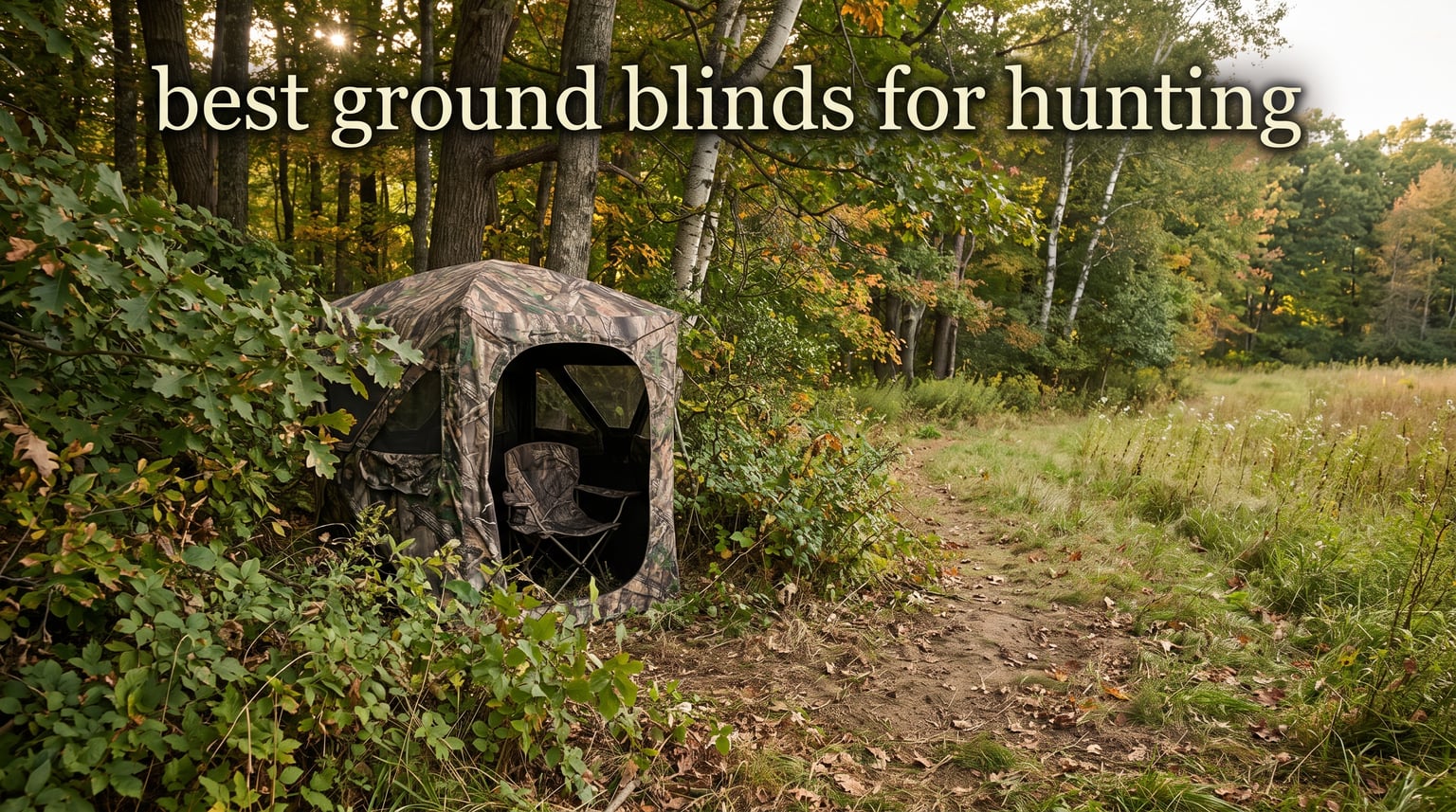
The best ground blinds for hunting make it easier to disappear at ground level without giving up the ability to watch an approaching deer or turkey. A good portable hunting blind combines usable sightlines, a quiet entry, fabric that stands up to the conditions, enough room for the way you hunt, and a setup you can manage where you hunt.
For this 2026 guide, I compared the listed construction, visibility layout, access design, included anchoring gear, capacity claims, ratings, and review volume for ten current options. I have not presented unverified field tests as fact; the recommendations below are editorial calls based on those published product details and the practical questions hunters repeatedly raise about solo setup, mesh, rain, noise, and visibility.
A ground blind is a portable or stationary concealment structure that blocks your silhouette and movement while you wait for game. See-through mesh and strategically opened windows can let you observe outside, but the blind still needs brush, a quiet routine, scent awareness, and enough time in place when deer are likely to notice a new object.
Start by matching the blind to your hunt. A bowhunter needs a broad, quiet shooting opening; a turkey hunter may care most about wide visual coverage; a group needs room and a door that does not create a traffic jam; and a cold-weather sit calls for a different fabric discussion than an early-season run-and-gun setup.
Table of Contents
The top 3 picks are the JOMAILIEEL 360, TIDEWE 270, and Lenotos 2-Person.
These are the three models I would narrow down first from the available data. The JOMAILIEEL 360 earns the overall slot for its 4.7 rating, four one-way vision panels, double doors, silent sliding windows, reinforced 300D material, and included ropes and spikes.
- JOMAILIEEL 360 See Through: Best overall for hunters who want 360-degree viewing, double-door access, and a choice of two capacities.
- TIDEWE 270 Full See Through: Best value for a 270-degree view, a blackout curtain, six windows, and a magnetic door.
- Lenotos 2-Person 360: Best compact pick for a listed 60-second setup, full mesh panels, a 65-inch center height, and a five-hub layout.
The three picks are not interchangeable. Choose the first for the broadest combination of listed access and viewing features, the TIDEWE when a curtain and magnetic entry matter, and the Lenotos when a smaller two-person pop-up blind suits the plan.


The best ground blinds for hunting in 2026 cover visibility, access, and weather needs.
The quick comparison below includes all ten products reviewed in this guide. I used the listed features rather than guessing at unstated specifications, so it is a useful first screen before reading the decision details in each review.
| Product | Specifications | Action |
|---|---|---|
| JOMAILIEEL 360 See Through |
|
Check Latest Price |
| TIDEWE 270 Full See Through |
|
Check Latest Price |
 TIDEWE 360 See Through TIDEWE 360 See Through |
|
Check Latest Price |
 Lenotos 2-Person 360 Lenotos 2-Person 360 |
|
Check Latest Price |
 JOMAILIEEL Diamond Door JOMAILIEEL Diamond Door |
|
Check Latest Price |
 FUNHORUN 270/360 FUNHORUN 270/360 |
|
Check Latest Price |
 HUNTSEN 270 HUNTSEN 270 |
|
Check Latest Price |
 Hunt Quiet 4-6 Person Hunt Quiet 4-6 Person |
|
Check Latest Price |
 ShedOFF Insulated ShedOFF Insulated |
|
Check Latest Price |
 Barronett Ace 250 Barronett Ace 250 |
|
Check Latest Price |
1. JOMAILIEEL 360 See Through is the most balanced all-around choice.
- Four one-way vision panels
- Double-door entry
- Silent sliding windows
- Includes ropes and spikes
- No stated insulation
- Listed warranty not provided
I put this JOMAILIEEL model first because its listed design addresses several ordinary blind frustrations at once: four one-way viewing panels, adjustable silent sliding windows, and double doors. The choice of a 1-2 person or 3-4 person version also makes it easier to match the blind to a solo deer sit, a hunting partner, or a small group.
The 4.7 rating is the highest in this group, although its 99 reviews are fewer than the review totals on some competing pop-up blind models. Its 300D material and reinforced seams are meaningful listed construction details, while the carry bag with strap, wind cords, ground spikes, and fast-storage design speak directly to transportation and anchoring.
For a deer blind, the double-door arrangement deserves attention. It can give a second person a way in or out without forcing everyone toward one opening, but you should still choose the entry side before the hunt and secure the supplied wind cords and spikes on arrival.
The viewing and entry layout serves two-to-four-person hunting plans.
Four one-way vision panels create a 360-degree viewing claim, which is useful when deer, turkey, or a hunting partner may approach from different directions. The silent sliding windows add a separate controlled opening, so the listed setup is not dependent on leaving a door or wide panel open.
Double doors are particularly relevant when a blind is occupied by more than one person. Put chairs, packs, and shooting lanes in place before light fades, since extra interior movement can be more visible than the blind fabric itself.
The fabric and anchoring package suits hunters who will stake the blind down.
The listed 300D material and reinforced seams provide a more specific construction description than a generic camouflage claim. The product also includes wind cords and ground spikes, so the anchoring components are part of the package rather than a separate assumption.
There is no listed insulation or warranty term in the analyzed data. Hunters planning cold, wet, or extended sits should treat those as separate questions and protect the carry bag from moisture during transport and storage.
2. TIDEWE 270 Full See Through is the clear pick for curtain control.
- Adjustable blackout curtain
- Six windows
- Magnetic silent door
- Metal hub
- View is not full 360 degrees
- No stated insulation
The TIDEWE 270 stands out because it pairs 270-degree one-way visibility with an adjustable sliding blackout curtain. I see that as a useful distinction for hunters who want to change the amount of light or visual exposure at the blind wall instead of committing to one fixed mesh arrangement.
Its 4.6 rating comes from 1,113 reviews, the largest review base among the first five options. The listed kit includes a carrying bag, four ropes, and eight stakes, while the durable metal hub and quick pop-up description keep the focus on the basic realities of carrying, opening, and securing a hub blind.
The six-window layout matters beyond the headline 270-degree visibility. It gives you discrete places to set observation and shooting openings, so you can face a likely travel route rather than treating the whole blind as one exposed wall.
The blackout curtain works for hunters who need adjustable visual cover.
The adjustable sliding blackout curtain is the feature that separates this model from a simple full-mesh shelter. Use it with a planned shooting lane: observe through the one-way material, then make only the opening changes the shot actually requires.
A curtain cannot replace good placement. Put the blind against brush, a field edge, or another background that breaks up the outline, and avoid setting it where an approaching deer will look directly at a hard new shape.
The magnetic door favors quiet, deliberate entries.
The product lists a magnetic silent door, an important detail for the start and end of a sit when fabric and zippers can create avoidable noise. Open and close it slowly during a daylight practice setup so you know where packs, chairs, and the door path will conflict.
This is a 270-degree blind rather than a stated full-360-degree model, and insulation is not listed. It is therefore a better match for a hunter who values its curtain and door features than one whose main requirement is all-around mesh visibility or a thermal layer.
3. TIDEWE 360 See Through is the better pick for window control.
TIDEWE Hunting Blind 360° Full See Through, 2-3 People 4-Sided Ground Blind
- Detachable blackout panel
- Ten sliding-rail windows
- 90-degree swing door
- Metal hubs
- No stated insulation
- More window choices need setup planning
This second TIDEWE option is the one I would consider when window configuration matters more than a single curtain-led design. It lists 360-degree unidirectional see-through material, a detachable blackout panel that switches between 270- and 360-degree coverage, and ten windows with dual silent sliding rails.
The 90-degree swing door is another notable difference. It may suit hunters who prefer a door that opens away from the entry path, and the available 2-3 person and 3-4 person sizes give it a wider capacity range than a strictly compact blind.
Metal hubs and 10 mm fiberglass support poles are the stated structural components. I would assemble the blind at home first, identify the door side and every likely shooting lane, then put the blackout panel and windows to work only after the site dictates which direction needs the most control.
The ten-window layout fits hunters who set distinct lanes.
Ten windows with dual silent sliding rails offer the most detailed window count in this roundup. That matters for bowhunting or gun hunting where a narrow lane toward a trail can be opened while other sides remain more closed.
More adjustment points also mean more decisions before game arrives. Set chair height, equipment position, and the chosen shooting windows before the active period rather than changing several rails when an animal is already close.
The size choices fit pairs and small hunting groups.
The listed 2-3 person and 3-4 person sizes let you choose space based on who will use the blind. Capacity labels are not a substitute for laying out chairs, packs, a bow, or a firearm safely, so treat them as a starting point rather than an interior floor-plan guarantee.
No insulation is listed in the analyzed product details. Hunters whose priority is warmth should compare this visibility-focused design with the ShedOFF insulated model later in the list.
4. Lenotos 2-Person 360 is the compact choice for fast setup.
- Listed 60-second setup
- Four see-through panels
- Five hubs
- Full-open door
- Built for two people
- No stated insulation
The Lenotos is the straightforward option for a hunter who wants a 2-person pop-up blind with a stated 60-second setup time. Its four full see-through mesh panels, five-hub design, reinforced stress points, fully open door, and 65-inch interior center height make the intended use easy to understand.
A 4.6 rating based on 353 reviews puts it in a strong middle position for feedback volume. The included four ropes and eight stakes are relevant for the forum concern that a blind needs to be manageable alone but still properly secured once it is open.
I would not interpret the listed setup time as permission to skip a trial run. Hub-style shelters are much easier to place quietly when you already know the opening sequence, how the carry bag packs, and where the stakes will go on uneven ground.
The stated 60-second setup suits mobile, prepared hunters.
The product calls out a 60-second setup, which makes it one of the clearer easy-setup hunting blind candidates in the group. That feature is most useful when the hunter has rehearsed the process and selected a site with enough open ground for the blind footprint.
For public land, check local rules before using any portable blind and avoid cutting natural cover just to create a perfect rectangle. Carry the bag, stakes, and ropes out with you; portable should also mean leaving the site clean.
The 65-inch center height informs comfort before the hunt.
The listed interior center height is 65 inches. Bring the chair you intend to use during a practice setup, because seat height affects both headroom and whether the window line meets your natural eye and shot position.
This is explicitly a two-person model, not a stated large-group shelter, and it has no listed thermal layer. It makes the most sense for a solo hunter with gear or two people keeping their equipment simple.
5. JOMAILIEEL Diamond Door is the pick for a light-blocking threshold.
- Diamond-shaped door
- Mud flap
- 360-degree viewing
- Reinforced stress points
- No stated insulation
- Listed warranty not provided
This JOMAILIEEL model earns its place because the diamond-shaped door and mud flap are unusually specific entry details. The blind also lists 360-degree see-through windows, reinforced stress points, a lightweight design, a portable carry bag, and a choice of 2-3 person or 3-4 person sizes.
In my view, the mud flap is the part worth comparing closely if your entry area is wet, muddy, or bright behind you. It is intended to block mud and light, although a careful, slow entry is still more important than any single panel when animals are already in range.
The main decision is whether the specialized door arrangement matches your site and habits. Practice walking through it with the clothing, pack, and equipment you will actually carry, then decide which direction the doorway should face before you stake the blind.
The mud flap helps address a messy or bright doorway.
The product lists a mud flap for blocking mud and light. That feature can be relevant on damp ground and when the doorway faces a brighter background, where an open threshold could make movement inside more noticeable.
Keep the floor area clear of loose wrappers, hard plastic, and gear that can scrape or shift. Quiet access comes from the full routine, including how equipment is placed before the first animal appears.
The capacity choices suit hunters who want one model line for different trips.
The 2-3 person and 3-4 person options create flexibility for solo, paired, and small-group outings. Select the smaller capacity when carrying volume and site space matter most, or the larger size when a partner and extra equipment need room.
There is no listed insulation or warranty term in the product data. For cold conditions, compare the fabric description and your clothing system rather than assuming that a standard see-through pop-up provides warmth.
6. FUNHORUN 270/360 is the waterproof-material choice for broad visibility.
- Waterproof polyurethane material
- Four one-way panels
- Full-open door
- One-minute setup
- No stated insulation
- Window configuration details are limited
The FUNHORUN blind is a sensible consideration when the published waterproof polyurethane material description is high on your checklist. It combines that fabric claim with four one-way panels, a full-open door, a one-minute pop-up design, a carrying bag, four ropes, eight stakes, and a stated choice of 2-, 3-, or 4-person capacities.
Its 4.5 rating is supported by 1,098 reviews, which is one of the largest feedback pools here. I would still read the product details as a starting point: waterproof material is not the same claim as a fully weatherproof system, and site drainage, seam care, anchoring, and dry storage remain part of the outcome.
The stated sturdy fiber support rod and included anchoring kit make it a classic hub-style ground blind package. It is a reasonable match for a hunter who wants broad one-way panels but does not need the more detailed ten-window layout of the TIDEWE 360.
The waterproof material is relevant for hunters planning around rain.
The product specifically lists waterproof polyurethane material, which is a more useful weather detail than a generic fabric label. Before a wet-weather sit, inspect the roof, seams, zippers, door edge, and the ground beneath the blind instead of relying on material language alone.
Choose slightly raised ground where water will not collect beneath the floor. Dry the blind fully before putting it back into the carry bag, because storing damp fabric can create odor and fabric-care problems.
The 2-, 3-, and 4-person choices cover changing group sizes.
This model line lists 2-, 3-, and 4-person capacity options. That is useful when the same hunter sometimes sits alone and sometimes brings a partner, but more occupants also mean more movement, more gear, and a greater need to set interior rules.
Detailed window counts and insulation are not provided in the analyzed listing. Choose it for its stated waterproof material, capacity range, and basic one-way-panel design rather than assuming specialized winter or window-control features.
7. HUNTSEN 270 is the simple option with a stated one-year warranty.
- Three unobstructed view panels
- Silent sliding windows
- Metal hubs
- One-year warranty
- No stated full 360-degree view
- No stated insulation
The HUNTSEN 270 offers a less complicated route to the core pop-up blind features: three full panels for a 270-degree unobstructed view, silent-sliding windows, high-quality polyester fabric, sturdy metal hubs, a carrying bag, and a claimed setup within one minute. It is listed for 2-3 or 3-4 people.
A stated one-year warranty is its most distinctive practical extra in this group. That matters because mesh, hubs, poles, zippers, and fabric are common worries in hunter discussions; a clear published warranty term gives buyers one concrete support point to verify at purchase.
The 4.5 rating across 748 reviews provides a larger feedback base than several newer entries. I would pick it when 270-degree coverage and silent sliding windows meet the plan, not when all-around visibility or specialized insulation is the deciding factor.
The one-year warranty gives buyers a specific support detail to check.
The listing includes a one-year warranty. Save the order information and inspect the blind during a daylight setup soon after it arrives, looking at the hubs, poles, fabric, mesh, window movement, stakes, ropes, and carry bag.
That inspection is a practical habit for any portable hunting blind, not an evaluation of a defect. It gives you time to understand the equipment before a hunt rather than discovering a missing or damaged item at the trailhead.
The 270-degree view fits sites with a defined approach direction.
Three full view panels can be enough when the likely approach is limited by a trail, field corner, creek edge, or terrain feature. Face the strongest viewing area toward that route and use cover behind the blind to reduce the visual impact of the solid side.
This model does not list full 360-degree coverage or insulation. Hunters who need a view in every direction should compare it with the 360-degree TIDEWE and JOMAILIEEL options.
8. Hunt Quiet 4-6 Person is the group option with steel hubs.
- Six one-way panels
- Heavy-duty steel hubs
- Silent-access door
- Blaze orange panels
- Designed for a larger group
- No stated insulation
The Hunt Quiet is the one to examine when the priority is a larger 4-6 person pop-up ground blind. Its listing calls out six 360-degree one-way see-through walls, heavy-duty steel hubs, a silent-access door, a stated 60-second deployment, and blaze orange safety panels.
Space is a real advantage only if it serves the hunt. I would reserve this model for a group, a mentor-and-new-hunter outing, or a situation where extra equipment needs a more generous interior, because a larger shelter also asks for a site with more clear ground and a well-planned carry route.
Six view panels and a silent-access door help separate observation from entry. The blaze orange panels are included, but hunters should still follow the safety and visibility rules that apply where they hunt rather than treating a removable panel as a universal answer.
The 4-6 person capacity fits planned group sits rather than quick solo moves.
The product is explicitly described as a 4-6 person shelter. Use that room to set seating positions, a clear entry lane, equipment zones, and each person’s observation or shooting direction before the hunt begins.
For a solo public-land hunt, a large footprint can be harder to carry, conceal, and site responsibly. A compact option may be the better portable hunting blind even when extra room sounds appealing on paper.
The steel hubs and orange panels suit hunters who prioritize stated structural and safety details.
Heavy-duty steel hubs are the listed support feature, while blaze orange safety panels are supplied for added visibility. Stake and rope the blind according to the included hardware, and periodically check tension when conditions change.
Its rating is 4.4 from 54 reviews, a much smaller review pool than the TIDEWE and FUNHORUN entries. The data also does not list insulation, so choose it for capacity, six-panel viewing, steel hubs, and access design rather than a cold-weather claim.
9. ShedOFF Insulated is the cold-weather option with a cotton layer.
- Thermal cotton layer
- 300D Oxford fabric
- Silent rail
- Includes tripod stool
- Three viewing windows
- Smaller review base
The ShedOFF is the clearest specialist model in this lineup because it lists a thermal insulated design with a cotton layer. It also specifies 300D Oxford fabric, three see-through mesh windows, a silent rail, a dual-zipper door, wind ropes, ground stakes, and a foldable tripod stool.
I would start here for a hunter whose main question is how to make a longer cold-condition ground blind sit more comfortable. The insulation claim does not remove the need for safe, weather-appropriate clothing, a dry setup, and a planned exit, but it is a real distinction from the uninsulated pop-up designs above.
The tradeoff is viewing coverage. With three listed see-through mesh windows, this blind is less focused on 270- or 360-degree mesh visibility, which may be perfectly sensible when a hunter has a known shooting direction and values the thermal layer more.
The cotton insulation answers a different need than all-around mesh visibility.
The product lists cotton insulation between its other cold-weather-oriented details. That makes it the most direct candidate for a hunter comparing insulated hunting blind options, rather than trying to turn a standard mesh shelter into a winter-specific setup.
Keep expectations grounded in the stated data: no temperature rating is provided. Pair the blind with appropriate layers, ground insulation, food and water planning, and a weather-aware hunt plan.
The three-window layout fits a focused shooting direction.
Three see-through mesh windows can work well when the hunt is built around a trail, feeder area, field edge, or other defined direction. The silent rail and dual-zipper door are relevant when you want to set openings and entry before game moves.
The 4.4 rating comes from 46 reviews, the smallest feedback base in the roundup. Consider that context alongside the specialized insulated construction and included foldable tripod stool.
10. Barronett Blinds Ace 250 is the bowhunting choice with shoot-through mesh.
- Adjustable panoramic window
- Shoot-through mesh for broadheads
- Brush holders
- Orange safety panels
- No stated insulation
- Smaller review base
The Barronett Blinds Ace 250 is the most clearly bowhunting-oriented selection because its listing includes shoot-through mesh for broadhead use. It also has a silent, adjustable panoramic front shooting window, rear peek windows, water-resistant HD 150 denier fabric, brush holders, blaze orange safety panels, a carry bag, ground stakes, and ropes.
I would give this model priority when the front shooting lane is the heart of the setup. A panoramic window can be more useful than a long list of small windows if you need to make a controlled shot through a known forward lane while retaining rear peek windows for awareness.
The brush holders give you a practical way to add natural material at the location. Use only loose, local vegetation where legal and avoid blocking the shooting window, ventilation, door, or the blind’s safe anchoring points.
The shoot-through mesh supports broadhead-focused bowhunting plans.
The listing specifically says its shoot-through mesh is for broadhead use. Confirm the manufacturer guidance for your own broadheads and practice only in a legal, safe setting before relying on any mesh panel during a hunt.
Set the bow, chair, and front window together during a dry run. A blind can conceal movement only if the draw, anchor, and shot path are possible without bumping fabric, poles, or a chair arm.
The panoramic front window and brush holders suit a defined front-facing setup.
The adjustable panoramic front shooting window is paired with rear peek windows, a helpful combination for watching the front while retaining limited awareness behind the blind. Brush holders can help attach legal natural cover to disrupt the outline at the site.
The listing gives a 4.4 rating from 40 reviews and does not state an insulation layer. Consider it for its named bowhunting features, not as the broadest-visibility or cold-weather leader.
Choose a ground blind by matching its layout to the hunt you actually plan.
The right blind is not simply the one with the largest capacity or the most mesh. Start with the location, the likely direction of travel, your weapon, the number of people, the expected conditions, and how far you must carry the shelter.
Visibility should match the approach routes and your shooting lanes.
See-through mesh is useful because it can block your silhouette while allowing observation, but different models offer different coverage. The JOMAILIEEL 360, TIDEWE 360, JOMAILIEEL Diamond Door, FUNHORUN, and Hunt Quiet list 360-degree viewing features; the TIDEWE 270 and HUNTSEN focus on 270-degree coverage; the ShedOFF lists three mesh windows; and the Barronett centers its layout on a panoramic front window plus rear peek windows.
Do not open every available window just because the blind has them. Identify the route you need to watch, make a safe and legal shooting plan, and keep other openings controlled so movement inside does not become the story outside.
Setup must be manageable before the pressure of hunting starts.
Forum discussions repeatedly return to blinds that are hard to open alone. Several of these products list quick setup or deployment: the Lenotos lists 60 seconds, the FUNHORUN and HUNTSEN list one minute, and the Hunt Quiet lists 60 seconds; treat those claims as reasons to practice, not as a substitute for practice.
At home, open the blind, locate the door, fit the poles or hubs as directed, attach the supplied ropes and stakes, and pack it again. Make a simple checklist for the carry bag, stakes, ropes, chair, safety items, and any legal cover material so a missing piece does not surprise you in the field.
Weather resistance starts with fabric but ends with site selection and care.
Look for precise material claims. The first JOMAILIEEL lists 300D material and reinforced seams, FUNHORUN lists waterproof polyurethane material, ShedOFF lists 300D Oxford with cotton insulation, and the Barronett lists water-resistant HD 150 denier fabric.
Those descriptions are helpful, but no portable fabric shelter eliminates the need to avoid low spots, stake and rope the blind, protect entry areas, and dry it before storage. If rain is likely, pay special attention to the roof shape, seams, window closures, door zippers, ground drainage, and whether the carry bag stays dry on the trip home.
Interior space should account for people, chairs, packs, and movement.
Capacity labels describe a broad range, not a promise that every occupant will be comfortable with full equipment. The Lenotos is a two-person model with a listed 65-inch center height, while the Hunt Quiet is stated for 4-6 people; the TIDEWE and JOMAILIEEL product lines offer several capacity choices.
Mock up the space before hunting. Place seats, backpacks, a bow or firearm, and a clear route to the door so nobody needs to step across a shooting lane when an animal is nearby.
Placement should make the blind less new and less noticeable.
Set the blind against a background such as brush, grass, a field edge, or a terrain break rather than in the center of an open area. Add legal, local natural cover where the blind offers brush holders or where attachment can be done safely, but leave windows, doors, mesh, and anchoring points functional.
How long before hunting should a ground blind be in place? When possible, give deer several days to get used to a new blind; longer can be helpful in a heavily watched area, while a brushed-in portable blind can still work for a last-second setup when site conditions demand it. There is no fixed number of days that overrides wind direction, entry route, human scent, and whether the blind looks out of place.
Scent and clothing choices should reduce movement and contrast inside the blind.
Scent control is not a listed feature of these products, so treat it as a system: clean gear, a low-impact route, attention to wind, and avoiding unnecessary movement. A blind hides the outline of the hunter better than an exposed position, but it does not make scent or careless entry disappear.
For the black-versus-camo question, dark clothing can reduce the bright human-shaped contrast behind see-through mesh in a darker blind interior. Camo can still make sense when moving outside or when the interior is exposed; the practical answer is to avoid bright contrast, backlight, and movement rather than relying on either clothing pattern alone.
Public-land use requires a smaller footprint and closer rule checks.
A portable pop-up blind can be useful on public land because it can be carried in and out, but regulations vary by area and season. Check rules on temporary structures, blaze orange, trimming vegetation, distance from trails or roads, and whether the blind must be removed daily.
Choose a model you can carry, set up, secure, and remove without leaving trace. A compact 2-person blind often makes more sense than a large group shelter when the site is distant, cover is limited, or the route crosses uneven ground.
Maintenance keeps the fabric, mesh, and hardware ready for the next hunt.
After each trip, remove dirt and plant material, let the blind dry completely, inspect mesh and windows, and check that every stake, rope, hub, and pole is accounted for. This is especially important after rain, mud, or a windy setup where tension may have shifted.
Store the blind dry in its carry bag and avoid forcing damp fabric into a tight package. A short daylight inspection before the next trip is far better than learning about a torn mesh panel or missing stake at the hunting site.
These FAQs answer the ground-blind questions hunters ask most often.
What are the best ground blinds for hunting?
The best ground blinds for hunting depend on the job. The JOMAILIEEL 360 See Through is the most balanced all-around pick for its four one-way panels, double doors, silent windows, reinforced 300D material, and included anchoring gear. Choose the TIDEWE 270 for its blackout curtain and magnetic door, the ShedOFF for its listed cotton insulation, or the Barronett Ace 250 for its shoot-through mesh and panoramic bowhunting window.
How long should a ground blind be in place before you deer hunt it?
When practical, place a ground blind several days before deer hunting so it becomes less new in the area. Longer can help in a heavily watched location. For a last-second setup, brush the blind into existing cover where legal, choose a sensible wind and entry route, keep movement low, and avoid placing a hard-edged shape in the middle of open ground.
Is it better to wear black or camo in a ground blind?
Dark clothing often reduces bright contrast behind see-through mesh in the darker interior of a ground blind. Camo can still be appropriate outside the blind or where the interior is exposed. The more important habits are staying still, avoiding bright backlighting, setting windows before game arrives, and keeping the blind against a natural background.
Will deer notice a ground blind?
Deer can notice a ground blind, especially if it suddenly appears in an open place or moves in the wind. Reduce that risk by setting it against brush or a field edge, staking and roping it securely, adding legal natural cover where appropriate, using a careful entry route, and allowing time for deer to accept the new object when possible.
The JOMAILIEEL 360 is the best all-around choice for 2026.
The JOMAILIEEL 360 See Through is my top recommendation because its published features combine broad one-way viewing, silent sliding windows, double-door access, 300D reinforced material, two capacity options, and included anchoring gear. The TIDEWE 270 is the strongest alternative when a blackout curtain and magnetic door take priority, while the Barronett Ace 250 and ShedOFF answer more specialized bowhunting and cold-condition needs.
The best ground blinds for hunting are the ones that fit your site, shooting lane, group size, and carry plan. Read the current product details, practice setup before the trip, stake the blind securely, and choose the model whose listed features solve the problem you actually have.