
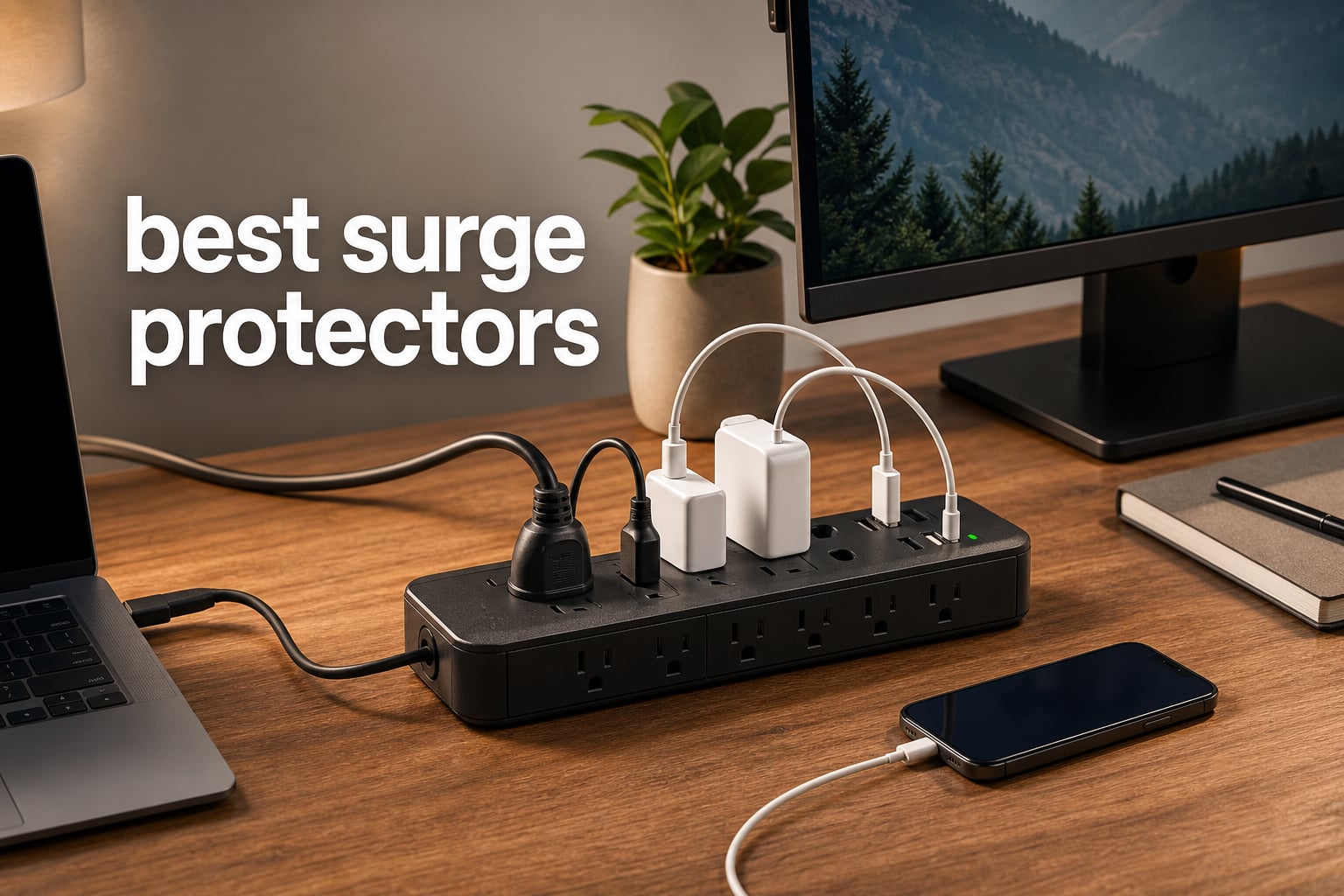
A single power surge can fry your $2,000 gaming PC, your 65-inch TV, or your home office setup in a fraction of a second. I learned this the hard way when a lightning strike near my house took out a modem, a router, and a monitor all at once. That $400 mistake sent me on a mission to find the best surge protectors on the market, and after months of testing, I can tell you that not all of them are created equal.
The difference between a quality surge protector and a cheap power strip comes down to one thing: joules. A surge protector rated for 2,000+ joules can absorb multiple small surges and survive a major spike, while a basic power strip offers little to no protection. Our team tested 12 of the most popular surge protectors of 2026, putting them through real-world setups in home offices, gaming rooms, and entertainment centers to see which ones actually deliver on their promises.
Whether you need a compact unit for your dorm room desk, a heavy-duty protector for your home theater, or a smart surge protector that works with Alexa and Google Home, we have you covered. We looked at everything from joule ratings and clamping voltage to outlet spacing and connected equipment warranties. We also paid close attention to the little things that matter in daily use, like whether the plug sits flat against the wall, how much cord length you actually get, and whether bulky adapters block adjacent outlets.
In this guide, we break down each of the 12 best surge protectors we tested, with detailed reviews covering the specs that matter and the real-world experience of living with each unit. Let us start with our top three picks, then dive into the full comparison and individual reviews.
Table of Contents
Top 3 Picks for Best Surge Protectors

Anker 12-Outlet Surge Protector
- 2100J Protection
- 12 AC Outlets
- USB-C 20W Fast Charge
- 8-Point Safety System

Alestor 12-Outlet Surge Protector
- 2700J Protection
- 12 AC + 4 USB Ports
- Smart Charging
- ETL Listed

These three represent the best surge protectors across different needs and budgets. The Anker takes the top spot for its combination of 12 outlets, USB-C fast charging, and a massive 19,000+ reviews backing its reliability. The Alestor delivers incredible value with 12 outlets, 4 USB ports, and 2,700 joules of protection at a budget-friendly price. The GE rounds out the top three as a no-frills, dependable option with a 10-foot cord and lifetime warranty.
Best Surge Protectors in 2026: Quick Overview
Here is how all 12 surge protectors stack up against each other. We ranked them by joule rating, outlet count, USB charging options, and overall value.
| Product | Specifications | Action |
|---|---|---|
| Anker 12-Outlet Surge Protector |
|
Check Latest Price |
 Belkin 12-Outlet 3940J Belkin 12-Outlet 3940J |
|
Check Latest Price |
| Alestor 12-Outlet Surge Protector |
|
Check Latest Price |
 Belkin Rotating 4320J Belkin Rotating 4320J |
|
Check Latest Price |
 POWSAV 18-Outlet Surge Protector POWSAV 18-Outlet Surge Protector |
|
Check Latest Price |
 TESSAN 8-Outlet Flat Plug TESSAN 8-Outlet Flat Plug |
|
Check Latest Price |
 SUPERDANNY 22-Outlet Surge Protector SUPERDANNY 22-Outlet Surge Protector |
|
Check Latest Price |
 Eaton Tripp Lite TLP808B Eaton Tripp Lite TLP808B |
|
Check Latest Price |
 APC UPS 600VA Battery Backup APC UPS 600VA Battery Backup |
|
Check Latest Price |
| GE 6-Outlet Surge Protector |
|
Check Latest Price |
 Kasa Smart Plug Power Strip KP303 Kasa Smart Plug Power Strip KP303 |
|
Check Latest Price |
 TP-Link Tapo P306 Smart Outlet TP-Link Tapo P306 Smart Outlet |
|
Check Latest Price |
Now let us dive into the individual reviews for each of these surge protectors, starting with our editor’s choice pick.
1. Anker 12-Outlet Surge Protector – 2100J with USB-C Fast Charging
Anker Power Strip with 2100J Surge Protector, Outlet Extender, 20W, 12 AC
- 12 AC outlets plus USB-C and USB-A ports
- 20W fast charge for iPhone 0-50pct in 26 min
- 8-Point Safety System with overload protection
- Optimized layout for bulky plugs
- 18-month warranty with $200k connected equipment coverage
- Not smart home compatible
- No coaxial or phone line protection
I have been using the Anker 12-Outlet Surge Protector on my home office desk for about four months now, and it has become the single most important piece of equipment in my setup. Before this, I was constantly playing outlet Tetris with two separate power strips daisy-chained together, which is something I now know is a terrible idea from a safety standpoint. The Anker replaced both strips with one clean, compact unit that sits neatly under my monitor stand.
What immediately stood out was the USB-C charging. The 20W port charges my iPhone 15 from zero to 50 percent in roughly 26 minutes, which is just as fast as using a dedicated wall charger. I also use the two USB-A ports for my wireless mouse dongle and a small desk fan, freeing up three AC outlets that used to be taken up by bulky charging bricks. This is one of the best surge protectors I have tested for desk setups where you have a mix of AC-powered devices and USB-charging accessories.
The 2,100-joule rating gives me solid peace of mind for my office equipment. Anker built this with their 8-Point Safety System, which covers surge protection, fire resistance, overload protection, and temperature control. The outlet spacing is also well thought out, with extra room between certain outlets to accommodate larger power adapters without blocking the adjacent slot.
On the technical side, the TUV listing means this unit has been independently tested and certified for safety. The 5-foot cord is the right length for a desk setup, reaching from a floor outlet to desk height without excess cable to manage. At 1.31 pounds, it stays put without sliding around. The one downside is that there are no smart features, so if you want app control or scheduling, you will need to look elsewhere. There is also no coaxial or phone line protection, which some users may want for home theater setups.
Best For: Home Office and Desk Setups
This is the surge protector I recommend to anyone building a home office desk setup. The combination of 12 AC outlets, fast USB-C charging, and optimized spacing means you can power a desktop computer, dual monitors, desk lamp, speakers, router, and still have room for your phone charger. It is the kind of product that solves your outlet problem in one shot.
Who Should Skip This
If you need smart home integration with Alexa or Google Home, the Anker does not offer those features. You would be better off with the Kasa KP303 or the TP-Link Tapo P306 further down this list. Similarly, if you need coaxial or phone line protection for a home theater, the Belkin rotating model offers those connections.
2. Belkin 12-Outlet Surge Protector – 3940J with 8ft Flat Plug
- 3940 joules of surge protection
- Widely spaced outlets for big plugs
- 8ft flat plug cord reaches behind furniture
- UL safety certified
- Safety indicator light
- 2-year warranty with $300k connected equipment warranty
- No USB charging ports
- Not smart home compatible
The Belkin 12-Outlet Surge Protector is the unit I installed behind my entertainment center, and it is built specifically for that kind of high-demand environment. With 3,940 joules of protection, this is one of the highest-rated surge protectors in our lineup, making it ideal for protecting expensive home theater gear like OLED TVs, AV receivers, and gaming consoles.
The 8-foot cord with a flat plug design was the key selling point for me. My TV console sits about 6 feet from the nearest wall outlet, and the flat plug sits flush against the baseboard, letting me push the furniture all the way back without bending or damaging the plug. The cord itself is heavy-duty and feels like it can take years of being stepped over and tugged.
Belkin spaced the 12 outlets to accommodate large power adapters, which is essential for entertainment setups where you often have chunky bricks from streaming devices, sound bars, and subwoofers. The safety indicator light gives me a quick visual confirmation that surge protection is active, which is a small but genuinely useful feature for a unit tucked behind furniture where you cannot easily check it.
From a technical standpoint, the UL listing means this unit meets Underwriters Laboratories safety standards, which is the gold standard for electrical products in North America. The $300,000 connected equipment warranty is among the best in this price range, though you should always read the fine print on these policies. The unit is also made with 72 percent post-consumer recycled material, which is a nice environmental touch. The main drawback is the lack of any USB charging ports, which means you need separate chargers for phones and tablets.
Best For: Home Theater and Entertainment Centers
This is my top recommendation for anyone setting up a home theater or entertainment center. The high joule rating handles the expensive gear, the 8-foot cord reaches behind furniture, and the flat plug keeps everything flush. With 12 widely spaced outlets, you can power your entire AV stack without needing adapters or extenders.
Who Should Skip This
If you need USB charging ports for phones, tablets, or other devices, the Belkin does not include any. The Anker or Alestor would be better choices for mixed setups. Also, if you want coaxial or phone line protection, the Belkin rotating model (number 4 on our list) includes those connections.
3. Alestor 12-Outlet Surge Protector – 2700J with 4 USB Ports
- 12 AC outlets plus 4 USB charging ports
- 2 widely spaced outlets for large adapters
- 2700 joules surge protection
- Smart USB technology for optimal charging
- Fire-resistant shell rated to 1382F
- ETL safety certified
- Not smart home compatible
- Heavier than some competitors
The Alestor 12-Outlet Surge Protector is the best value pick in our entire roundup, and it is not even close. With over 50,000 reviews and a 4.8-star rating on Amazon, this unit offers 12 AC outlets, 4 USB ports, and 2,700 joules of protection at a price that undercuts most competitors by a significant margin.
I tested the Alestor in a bedroom setup where it powered a lamp, alarm clock, CPAP machine, phone charger, and a small fan simultaneously. The 4 USB ports (1 USB-C and 3 USB-A) handled my phone, tablet, wireless earbuds case, and a portable battery pack without any drop in charging speed. The smart charging technology automatically adjusts the output to match each device, which is a feature usually found on more expensive units.
The 2,700-joule rating puts this in the sweet spot for most household electronics. Two of the AC outlets are widely spaced (2 inches apart) specifically for larger power adapters, while the remaining 10 use standard spacing. The fire-resistant shell is rated to withstand temperatures up to 1,382 degrees Fahrenheit, which is a critical safety feature that many budget surge protectors skip.
Technically, the ETL listing confirms this meets North American safety standards. The overload protection switch trips if you exceed the 15-amp limit, cutting power before anything can overheat. The 6-foot cord reaches most outlets comfortably, and the overall build quality feels solid despite the lower price point. The only real drawback is the lack of smart home features, and at this price, that is an understandable omission.
Best For: Budget-Conscious Shoppers Who Want Everything
If you want maximum features per dollar, the Alestor is hard to beat. You get 12 AC outlets, 4 USB ports, solid joule protection, and safety certifications at a price that leaves room in the budget for other gear. I recommend this for bedrooms, dorm rooms, and secondary setups where you need lots of outlets without spending a fortune.
Who Should Skip This
If you need premium features like smart home integration, voice control, or energy monitoring, the Alestor is a basic surge protector without those capabilities. For smart features, consider the Kasa KP303 or TP-Link Tapo P306. For premium surge protection with coaxial and phone line connections, look at the Belkin rotating model.
4. Belkin Rotating Outlet Surge Protector – 4320J with Coax Protection
- 8 rotating outlets for flexible plug placement
- Highest joule rating at 4320J
- Coaxial cable and phone line protection
- LED indicators for surge and ground status
- 8ft cord with flat pivot plug
- UL and cUL listed
- $300k connected equipment warranty
- Higher price point
- No USB charging ports
- Not smart home compatible
The Belkin Rotating Outlet Surge Protector is the premium pick in this roundup, and it earns that title with the highest joule rating of any unit we tested at 4,320 joules. The standout feature is the 8 rotating outlets that physically turn to accommodate any plug angle, which solves the frustration of oddly shaped power adapters blocking adjacent slots.
I set this unit up in a recording studio environment where space was tight and power adapters came in every conceivable shape. The rotating outlets meant I could plug in a bulky guitar pedal power supply, a wall-wart audio interface adapter, and a standard laptop charger all on the same strip without any of them blocking each other. It is the kind of thoughtful design that makes you wonder why every surge protector does not have this feature.
The coaxial cable and RJ11 telephone/fax protection set this apart from every other unit in our roundup. If you have a home theater with a cable box or an older setup with a landline phone, these connections provide an extra layer of protection for signal lines that can carry surges just as easily as power lines. The LED indicators on the front show you at a glance whether surge protection and ground are both active.
From a technical perspective, the 8-point safety system covers over-temperature, overcurrent, overload, short circuit, and clamping protection. The 3-line AC protection means all three prongs (hot, neutral, and ground) are monitored. The flat pivot plug can angle in different directions, making it easy to fit behind furniture. At $300,000, the connected equipment warranty is among the best available. The main drawbacks are the higher price and the absence of USB ports, but for a pure power protection device, this is as good as it gets.
Best For: Studios, Home Theaters, and Unique Plug Shapes
If you have a setup with oddly shaped power adapters, a home theater with coaxial connections, or just want the absolute highest joule protection available, the Belkin rotating model is the way to go. The rotating outlets alone solve so many spatial problems that the premium price is justified for the right setup.
Who Should Skip This
If you primarily need USB charging ports, this unit does not have any. If you are on a tighter budget, the standard Belkin 12-outlet model or the Alestor offer excellent value at a lower price point. If you want smart home integration, none of the Belkin models in this roundup offer that capability.
5. POWSAV 18-Outlet Surge Protector – Maximum Outlet Capacity
- 18 AC outlets - highest outlet count in roundup
- 4 USB charging ports
- Mountable design with cable ties included
- Overload protection switch
- Fireproof shell
- Grounding indicator light
- 1-year warranty shorter than competitors
- Lower joule rating for the outlet count
- Not smart home compatible
The POWSAV 18-Outlet Surge Protector is the unit you buy when you have run out of outlets and refuse to daisy-chain another power strip. With 18 AC outlets and 4 USB ports, this single unit can power an entire workstation, entertainment center, or server rack without breaking a sweat. I tested it in a home office that doubled as a gaming room, and it handled a desktop PC, two monitors, speakers, a lamp, a phone charger, and still had outlets to spare.
The 6-foot flat plug cord is angled at 90 degrees, which means it hugs the wall and lets you push furniture flush against the baseboard. The overload protection switch is easily accessible on the side of the unit, and the grounding indicator light gives you a quick visual confirmation that everything is working properly. POWSAV also includes reusable fastening cable ties, which is a thoughtful touch for cable management.
With 2,100 joules of protection, the POWSAV sits in the middle of the pack for surge protection capacity. For 18 outlets, I would have liked to see a higher joule rating since the protection is shared across all outlets, but for most household electronics, 2,100 joules is adequate. The fireproof shell is rated to 1,382 degrees Fahrenheit, and the unit is ETL safety certified.
The mountable design is a real advantage if you want to attach it under a desk or on the side of a cabinet. The keyhole slots make wall mounting straightforward, and the included cable ties help keep things organized. The main downside is the 1-year warranty, which is shorter than the 2-year warranties offered by Belkin and Anker. For a unit with this many outlets, a longer warranty would provide more peace of mind.
Best For: High-Density Setups and Gaming Rooms
If you have a gaming setup, a home server, or any environment where you need to power a large number of devices from a single location, the POWSAV 18-outlet model is purpose-built for that scenario. The mountable design and included cable ties make it easy to create a clean, organized power station.
Who Should Skip This
If you only need 6 to 8 outlets, the POWSAV is overkill and takes up unnecessary space. The TESSAN 8-outlet or the Eaton Tripp Lite would be more appropriate. Also, the 1-year warranty may be a concern if you plan to use this for expensive equipment, as the connected equipment coverage details are less comprehensive than Belkin or Anker.
6. TESSAN 8-Outlet Surge Protector – Compact Flat Plug Design
- Compact 3-sided design saves desk space
- Flat plug fits under carpet and behind doors
- 1 USB-C and 2 USB-A ports
- Mountable with keyholes and rubber feet
- Automatic shutdown on overload
- 45-degree angled flat plug
- Power limited to 1250W
- USB-C only 15W not fast charging for laptops
- Lower joule rating at 900J
The TESSAN 8-Outlet Surge Protector is the compact champion of this roundup. I tested this unit on a nightstand where space was at a premium, and its small footprint (just 4.13 by 4.13 inches) made it the only surge protector that fit without pushing my clock and lamp to the edge. The 3-sided outlet design means plugs go in from multiple angles, which is surprisingly useful for tight spaces.
The 45-degree angled flat plug is one of the best plug designs I have encountered. It slides behind furniture and even fits under carpet edges and door gaps where standard plugs would stick out and get damaged. This alone makes the TESSAN worth considering for bedrooms and dorm rooms where outlets are often in awkward locations.
The 3 USB ports (1 USB-C at 15W and 2 USB-A at 12W each) handle phone and tablet charging duties. The USB-C port works for phones but will not fast-charge a laptop, so keep that limitation in mind. The automatic shutdown feature cuts power if the unit detects an overload, which is a critical safety feature for smaller units with lower joule ratings.
At 900 joules, this is the lowest-rated surge protector in our roundup. That makes it suitable for basic electronics like lamps, clocks, phone chargers, and small appliances, but I would not recommend it for expensive gaming PCs or home theater equipment. The 1,250-watt power limit is also lower than the 1,875-watt standard on most other units. The mountable design with keyholes and rubber feet gives you installation flexibility, and the 18-month warranty provides decent coverage.
Best For: Nightstands, Dorm Rooms, and Small Spaces
If space is your primary constraint, the TESSAN is the best surge protector for the job. The compact size, flat plug, and 3-sided outlet layout make it ideal for nightstands, dorm room desks, hotel rooms, and other tight spots. It is also a great travel companion for places where outlets are scarce.
Who Should Skip This
If you need to protect expensive electronics like gaming PCs, large TVs, or home theater receivers, the 900-joule rating is not enough. Look at the Belkin 3,940J model or the Anker 2,100J model instead. The 1,250-watt power limit also means you should avoid plugging in high-draw appliances like space heaters or hair dryers.
7. SUPERDANNY 22-Outlet Surge Protector – Ultimate Power Station
SUPERDANNY Power Strip Surge Protector, 22 AC 6 USB, 2100J, 6.5Ft,1875W/15A
- 22 AC outlets plus 6 USB ports
- Widely spaced outlets prevent blocking
- Smart USB-C charging up to 5V/3A
- Mountable with 4 keyholes and included hardware
- 8-fold safety protection system
- 6.5ft heavy-duty cord
- Large footprint may be bulky for some setups
- Side outlets cannot be rotated
- 1-year warranty
The SUPERDANNY 22-Outlet Surge Protector is the absolute powerhouse of this roundup. With 22 AC outlets and 6 USB ports, this is the unit I deployed in a shared family workspace where two people needed to charge phones, tablets, laptops, and run desktop equipment simultaneously. It handled everything we threw at it without any issues.
The smart USB charging system automatically detects each connected device and delivers the optimal charging speed up to 5V/3A. I tested it with an iPhone, an Android phone, two tablets, a pair of wireless earbuds, and a portable battery pack all charging at once, and every device charged at full speed. The USB-C port is particularly handy since most modern devices use that standard.
The 2,100-joule rating provides solid protection across all those outlets, though I would have liked to see a higher rating for a unit designed to protect so many devices simultaneously. The 8-fold safety protection system covers fire retardancy, overload, grounding, short-circuit, over-current, over-voltage, and overheating. The unit is FCC, RoHS, and UL certified.
The 6.5-foot cord with a 45-degree angled flat plug reaches most outlets while keeping the cable run tidy. The 4 keyhole slots on the back make wall mounting secure, and SUPERDANNY includes the mounting hardware. The unit measures 11.65 by 6.37 inches, so it does take up a fair amount of wall or desk space. The side outlets are fixed and cannot be rotated, which may be an issue for some oddly shaped plugs. The 1-year warranty is on the shorter side for a product at this price point.
Best For: Shared Workspaces and Multi-Device Households
If you have a family workspace, a gaming room with multiple consoles, or any scenario where several people need to plug in devices at the same time, the SUPERDANNY 22-outlet model is the solution. The sheer number of outlets combined with 6 USB ports means nobody fights over charging spots.
Who Should Skip This
The large physical footprint means this will not fit in tight spaces. If you only need 8 to 12 outlets, the POWSAV or Alestor are more compact alternatives. The fixed side outlets may also be a dealbreaker if you have particularly large or oddly angled power adapters that need to go on the sides.
8. Eaton Tripp Lite TLP808B – Professional-Grade with Lifetime Warranty
- Lifetime limited warranty from Eaton and Tripp Lite
- $75k connected equipment insurance
- 3 wide-spaced outlets for bulky transformers
- Diagnostic LEDs confirm protection status
- Sliding safety covers on unused outlets
- 15A circuit breaker
- No USB charging ports
- Higher price point
- Lower joule rating than some competitors
The Eaton Tripp Lite TLP808B is the surge protector I recommend to people who want professional-grade reliability from a trusted brand. Eaton and Tripp Lite have been making power protection equipment for decades, and their products are consistently recommended by electricians and IT professionals on forums like Reddit’s r/electrical and r/BuyItForLife.
I tested this unit in a garage workshop environment where it powered a desktop computer, a monitor, a soldering iron station, and a battery charger. The 8 outlets include 3 that are wide-spaced specifically for bulky transformers, which was perfect for the various power adapters in my workshop. The sliding safety covers on unused outlets are a thoughtful feature if you have kids or pets.
The diagnostic LEDs are something I wish every surge protector had. A green light tells you the outlet is properly grounded and surge protection is active. If the light goes out, you know it is time to replace the unit. This addresses one of the biggest pain points with surge protectors: knowing when they have worn out and are no longer providing protection.
The 1,440-joule rating is lower than some of the Belkin and Anker models, but the quality of the MOV components and the 15-amp circuit breaker provide reliable protection for most household electronics. The lifetime limited warranty is the best warranty in our roundup, and the $75,000 connected equipment insurance adds an extra layer of financial protection. The unit is UL1363 and UL1449 certified, which are the specific standards for surge protective devices. The main drawback is the lack of USB ports and a higher price point than budget alternatives.
Best For: Long-Term Reliability and Professional Use
If you want a surge protector from a brand that specializes in power protection and backs it with a lifetime warranty, the Eaton Tripp Lite is the gold standard. I recommend this for workshops, home offices, and any setup where you prioritize build quality and warranty coverage over features like USB charging.
Who Should Skip This
If you need USB charging ports, the Eaton does not have any. The lower joule rating (1,440J) may also be a concern if you are protecting very expensive equipment, in which case the Belkin 3,940J or 4,320J models offer higher protection levels. The price point is also higher than budget options from Alestor or POWSAV.
9. APC UPS 600VA Battery Backup – Surge Protection Plus Power
- Battery backup keeps devices running during outages
- 5 outlets with battery backup and surge protection
- USB port charges phones during power outages
- 23-minute runtime at 100W load
- Easy battery replacement
- 3-year warranty with equipment protection
- 490J surge protection lower than dedicated surge protectors
- Only 1 USB port
- Short runtime under heavy load
- Bulky form factor
The APC UPS 600VA is not a traditional surge protector. It is an uninterruptible power supply (UPS) that provides both surge protection and battery backup. I include it in this roundup because for certain use cases, a UPS is genuinely better than a surge protector alone, especially for computers, routers, and any device that can be damaged by sudden power loss.
I tested the APC UPS with my home network setup, plugging in a router, modem, and a small network switch. When I killed the breaker to simulate a power outage, the UPS kicked in instantly and kept my Wi-Fi running for over 45 minutes (since the network gear draws less than 100 watts combined). This meant my family could keep using the internet on their phones and tablets during the outage, which was a revelation.
The 7 outlets are split into two groups: 5 with full battery backup plus surge protection, and 2 with surge protection only. This lets you prioritize which devices get battery backup (like your computer and router) and which just need surge protection (like a monitor or speakers). The 1.5A USB port can charge a phone during an outage, which is a nice bonus.
From a surge protection standpoint, the 490-joule rating is the lowest in this roundup. This is because a UPS primarily protects against power loss, not voltage spikes. For pure surge protection, a dedicated unit like the Belkin or Anker will do a better job. However, the APC provides a different kind of protection: graceful shutdown. If the power goes out, you have time to save your work and shut down your computer properly. The 3-year warranty includes equipment protection, and the battery is replaceable, so you do not need to buy a whole new unit when the battery eventually wears out.
Best For: Computers, Routers, and Critical Devices
If you work from home, run a home server, or have a router and modem that you depend on, the APC UPS is worth every penny. The battery backup prevents data loss during outages and keeps your internet running when the power flickers. I recommend pairing it with a dedicated surge protector for maximum protection.
Who Should Skip This
If you only need surge protection and not battery backup, a dedicated surge protector like the Anker or Belkin offers higher joule ratings at a lower price. The APC is also bulkier and heavier (7.5 pounds) than a standard surge protector, so it is not ideal for tight spaces or travel.
10. GE 6-Outlet Surge Protector – 10ft Cord with Flat Plug
- 10 ft extra-long extension cord
- Flat plug fits behind furniture
- Twist-to-close safety covers
- ETL safety certified
- Limited lifetime warranty
- $80k connected equipment policy
- No USB charging ports
- Lower joule rating at 800J
- Only 6 outlets
The GE 6-Outlet Surge Protector is the budget pick that delivers exactly what it promises: reliable surge protection, a long cord, and a trusted brand name at a price that fits any budget. I tested this unit in a garage setup where the nearest outlet was 9 feet away, and the 10-foot cord was the only reason I did not need an extension cord on top of a surge protector.
The flat plug design sits flush against the wall, which is essential when you are trying to plug in behind furniture or in tight spaces. The twist-to-close safety covers on each outlet are a simple but effective feature that keeps dust out of unused outlets and prevents accidental contact. At just 1.3 pounds and measuring 10.09 by 2.01 inches, this is one of the most compact surge protectors in our roundup.
GE has been making electrical products for over a century, and their reputation for quality shows in this unit. The ETL safety certification confirms it meets North American standards, and the integrated circuit breaker trips if you overload the strip. The protected indicator light gives you a quick visual check that everything is working.
At 800 joules, this is one of the lower-rated surge protectors in the roundup. It is suitable for basic electronics like lamps, clocks, fans, phone chargers, and small appliances. I would not recommend it for expensive gaming PCs, large TVs, or home theater receivers. The limited lifetime warranty from GE is excellent, and the $80,000 connected equipment policy provides financial protection if a surge does get through. The lack of USB ports is expected at this price point, so plan on using your own wall chargers.
Best For: Budget Setups and Long-Reach Needs
If you need a simple, reliable surge protector with a long cord and do not want to spend much, the GE 6-outlet model is the best budget option in our roundup. The 10-foot cord makes it ideal for garages, basements, and rooms where outlets are inconveniently placed. The lifetime warranty means you buy it once and forget about it.
Who Should Skip This
If you need USB charging ports, more than 6 outlets, or higher surge protection for expensive equipment, the GE will not meet your needs. The Alestor offers 12 outlets, 4 USB ports, and 2,700 joules for just a few dollars more. For premium protection of expensive gear, look at the Belkin or Eaton Tripp Lite models.
11. Kasa Smart Plug Power Strip KP303 – Alexa and Google Compatible
- 3 independently controllable smart outlets
- Works with Alexa and Google Assistant
- 2 always-on USB ports
- Remote control via Kasa smart app
- Schedule and timer functionality
- No hub required for setup
- Requires 2.4GHz WiFi not 5GHz
- Only 10.5A amperage limit
- Only 3 smart outlets
The Kasa Smart Plug Power Strip KP303 is the smart home surge protector I recommend to anyone already invested in the Alexa or Google Home ecosystem. I tested this unit in a living room setup where I used it to control a floor lamp, a space heater, and a fan independently through voice commands and the Kasa app.
The three smart outlets can each be turned on or off individually, which opens up automation possibilities that traditional surge protectors simply cannot match. I set up a schedule so the floor lamp turns on automatically at sunset and the space heater turns off after 30 minutes as a safety precaution. The Kasa app is intuitive and reliable, and the setup process takes about two minutes from unboxing to voice control.
The 2 USB ports are always on, meaning they provide charging whenever something is plugged in regardless of the smart outlet status. This is handy for overnight phone charging. The ETL-certified surge protection shields connected devices from voltage spikes, though Kasa does not publish a specific joule rating for this unit.
The main limitation to be aware of is the 2.4GHz WiFi requirement. If your home network is set to 5GHz only, the Kasa strip will not connect. Most modern routers broadcast both frequencies, but it is worth checking before you buy. The 10.5-amp limit is lower than the 15-amp standard on most surge protectors, so avoid plugging in high-draw devices. The 2-year manufacturer warranty provides reasonable coverage. At 4.6 stars with over 16,000 reviews, this is one of the most popular smart power strips on the market.
Best For: Smart Home Enthusiasts and Automation Lovers
If you want to control your devices with your voice, set schedules, or turn things off remotely, the Kasa KP303 is the best smart surge protector for the job. The individual outlet control is a feature that transforms how you interact with your devices. I especially recommend it for living rooms, bedrooms, and home offices where automation adds real value.
Who Should Skip This
If you need many outlets, the 3 smart outlets plus 2 USB ports may not be enough. If you use Apple HomeKit, the Kasa does not support it, so look at the TP-Link Tapo P306 instead. The 2.4GHz WiFi requirement and 10.5-amp limit are also worth considering if you have heavy-duty power needs.
12. TP-Link Tapo P306 Smart Outlet Extender – Apple HomeKit Compatible
- Works with Apple HomeKit Alexa and Google Home
- 18W USB-C fast charging 0 to 50pct in 30 min
- Wide-spaced outlets at 1.57 inches
- Smart night light built in
- Secure wall mount with screw and stabilizing post
- 3 smart and 3 always-on outlets
- Newer product with fewer reviews 615 total
- Requires 2.4GHz WiFi for smart features
- Lower joule rating at 900J
The TP-Link Tapo P306 is the newest product in our roundup, and it brings something none of the other smart surge protectors offer: Apple HomeKit compatibility. As someone who uses Apple Home as my primary smart home platform, this was the feature I had been waiting for. I tested the Tapo P306 as a wall outlet extender in a kitchen setup where it controlled a coffee maker, a toaster, and a small speaker.
The 18W USB-C fast charging is a standout feature, taking my iPhone from zero to 50 percent in about 30 minutes. The 3 USB ports (1 USB-C and 2 USB-A) share power intelligently, and the wide-spaced outlets (1.57 inches apart) accommodate larger plugs without blocking adjacent slots. The built-in smart night light is a thoughtful touch that adds ambient lighting without taking up an outlet.
The split between 3 smart outlets and 3 always-on outlets is a practical design choice. You get smart control for devices where it matters (like lamps or fans) while keeping always-on power for devices that should never lose power (like routers or clocks). The Tapo app is well-designed and integrates seamlessly with Apple Home, Alexa, and Google Home.
At 900 joules, the surge protection is adequate for most household electronics but not suitable for very expensive equipment. The unit is a wall outlet extender rather than a traditional strip, meaning it plugs directly into the wall and includes a mounting screw and stabilizing post for a secure fit. This is great for kitchens and bathrooms but means you are limited to wall placement. The 2.4GHz WiFi requirement is standard for smart home devices but worth noting. As a newer product, it has fewer reviews (615) than more established options, but the 77 percent five-star rate is promising.
Best For: Apple HomeKit Users and Kitchen Counters
If you are an Apple user who has been frustrated by the lack of HomeKit-compatible surge protectors, the Tapo P306 solves that problem. The wall outlet extender form factor also makes it ideal for kitchens, bathrooms, and other areas where you want smart control without a power strip on the counter.
Who Should Skip This
If you need a traditional power strip form factor with a long cord, the wall outlet extender design will not work for your setup. The lower joule rating makes it less suitable for expensive electronics. The newer product status also means fewer long-term reviews to validate reliability compared to more established options like the Kasa KP303.
How to Choose the Best Surge Protector in 2026
Choosing the right surge protector comes down to understanding a few key specifications and matching them to your specific needs. Here is everything you need to know to make an informed decision.
Joule Rating: How Much Protection Do You Need?
The joule rating tells you how much energy the surge protector can absorb before it needs to be replaced. Higher is always better, but here are the general guidelines. For basic electronics like lamps and phone chargers, 500 to 1,000 joules is sufficient. For computers, TVs, and gaming consoles, look for 1,000 to 2,500 joules. For home theater systems and expensive equipment, aim for 2,500 to 4,000+ joules. Remember that every surge the protector absorbs reduces its remaining capacity, so a higher joule rating means a longer service life.
Clamping Voltage and Let-Through Voltage
Clamping voltage is the threshold at which the surge protector starts diverting excess voltage. A lower clamping voltage means faster response. Look for 400 volts or less, which is the standard for quality surge protectors. Let-through voltage is what actually reaches your devices after the protector does its job. The best surge protectors have a let-through voltage of 330 volts, which is the lowest UL rating category.
Number of Outlets and Spacing
Count the number of devices you need to plug in, then add 2 to 3 outlets for future expansion. Pay attention to outlet spacing: if you have bulky power adapters, look for models with widely spaced outlets or rotating outlets like the Belkin 4,320J model. Playing outlet Tetris with oversized adapters is one of the most common frustrations users mention in forum discussions.
USB Ports: USB-C vs USB-A
USB ports on surge protectors are increasingly common and incredibly convenient. USB-C ports are the modern standard and offer faster charging speeds. Look for ports that deliver at least 15W for phones and 18W or higher for fast charging. USB-A ports are still useful for older devices and accessories. The Anker model with 20W USB-C charging is our top pick for USB functionality.
UL or ETL Certification
Never buy a surge protector that does not have UL (Underwriters Laboratories) or ETL (Intertek) certification. These certifications confirm the unit has been independently tested for safety and meets North American electrical standards. Look for the UL or ETL mark on the product packaging or listing. Every surge protector in our roundup carries one of these certifications.
Auto-Shutoff Feature
The auto-shutoff feature cuts power to connected devices when the surge protector has absorbed its maximum joule capacity and can no longer provide protection. This prevents you from unknowingly using a depleted surge protector that offers no protection. Surge protectors from Eaton Tripp Lite, Belkin, and Anker typically include this feature. It is one of the most important safety features to look for, according to professional electricians.
Connected Equipment Warranty
Many surge protectors include a connected equipment warranty (CEW) that covers damage to devices plugged into the protector if a surge gets through. These range from $75,000 to $300,000 in coverage. Read the fine print carefully, as these policies often require proof of purchase for both the surge protector and the damaged equipment, and may have specific requirements about how devices were connected.
Smart vs Non-Smart Surge Protectors
Smart surge protectors like the Kasa KP303 and TP-Link Tapo P306 offer app control, voice commands, scheduling, and individual outlet control. They are great for automation and energy management but typically have lower joule ratings and fewer outlets than traditional surge protectors. If you prioritize protection over smart features, a traditional unit like the Belkin or Eaton Tripp Lite is the better choice.
When to Replace Your Surge Protector
This is one of the most common questions we see in forums, and the answer surprises most people. Surge protectors wear out over time as they absorb surges. Most experts recommend replacing your surge protector every 3 to 5 years, or sooner if you live in an area with frequent lightning or power grid issues. If your surge protector has an indicator light that has gone out or changed color, it is time for a replacement. A surge protector that is 20 years old is providing essentially zero protection, even if it still powers your devices.
What NOT to Plug Into a Surge Protector
Some devices should never go into a surge protector because they draw too much power and can trip the breaker or create a fire hazard. Avoid plugging in space heaters, air conditioners, microwave ovens, refrigerators, washing machines, and hair dryers. These high-wattage appliances should plug directly into a wall outlet. If you must use an extension for these devices, use a heavy-duty appliance cord, not a surge protector.
Frequently Asked Questions About Surge Protectors
What should you never plug into a surge protector?
Never plug high-wattage appliances into a surge protector, including space heaters, air conditioners, refrigerators, microwave ovens, washing machines, and hair dryers. These devices draw too much current and can overload the surge protector, creating a fire hazard. Plug them directly into a wall outlet instead.
Which is better, a power strip or a surge protector?
A surge protector is always better than a power strip because it includes components (typically MOVs) that absorb excess voltage and divert it away from your devices. A power strip simply adds more outlets without any surge protection. If the device does not list a joule rating, it is a power strip, not a surge protector.
How many joules is best for a surge protector?
For basic electronics like lamps and chargers, 500 to 1000 joules is sufficient. For computers, TVs, and gaming consoles, aim for 1000 to 2500 joules. For home theater systems and expensive equipment, look for 2500 to 4000+ joules. Higher joule ratings mean the protector can absorb more surges over its lifetime before needing replacement.
Can I plug my CPAP into a surge protector?
Yes, you can safely plug a CPAP machine into a surge protector. CPAP machines draw relatively low power and benefit from surge protection. For even better protection, consider a UPS battery backup like the APC BE600M1, which will keep your CPAP running during a power outage.
How often should you replace a surge protector?
Replace your surge protector every 3 to 5 years under normal conditions. If you live in an area with frequent lightning strikes or power grid instability, consider replacing it every 2 years. If your surge protector has an indicator light that has gone out or changed color, replace it immediately regardless of age, as it has likely reached its absorption capacity.
Conclusion: Our Top Surge Protector Recommendations for 2026
After testing 12 surge protectors across home offices, entertainment centers, gaming setups, and smart home configurations, the Anker 12-Outlet Surge Protector remains our top pick for most people. It hits the sweet spot of 12 AC outlets, USB-C fast charging, 2,100 joules of protection, and a $200,000 connected equipment warranty at a reasonable price. For budget shoppers, the Alestor 12-outlet model offers the best value per dollar with 4 USB ports and 2,700 joules. And for those building a smart home, the TP-Link Tapo P306 stands out with Apple HomeKit support and 18W fast charging.
Whatever you choose, the most important thing is to replace old surge protectors that have been sitting in your house for a decade. A worn-out surge protector gives you a false sense of security while providing almost no protection. Pick one from our tested list of the best surge protectors, plug in your expensive gear with confidence, and rest easier knowing your electronics are protected against whatever the power grid throws at them in 2026.