
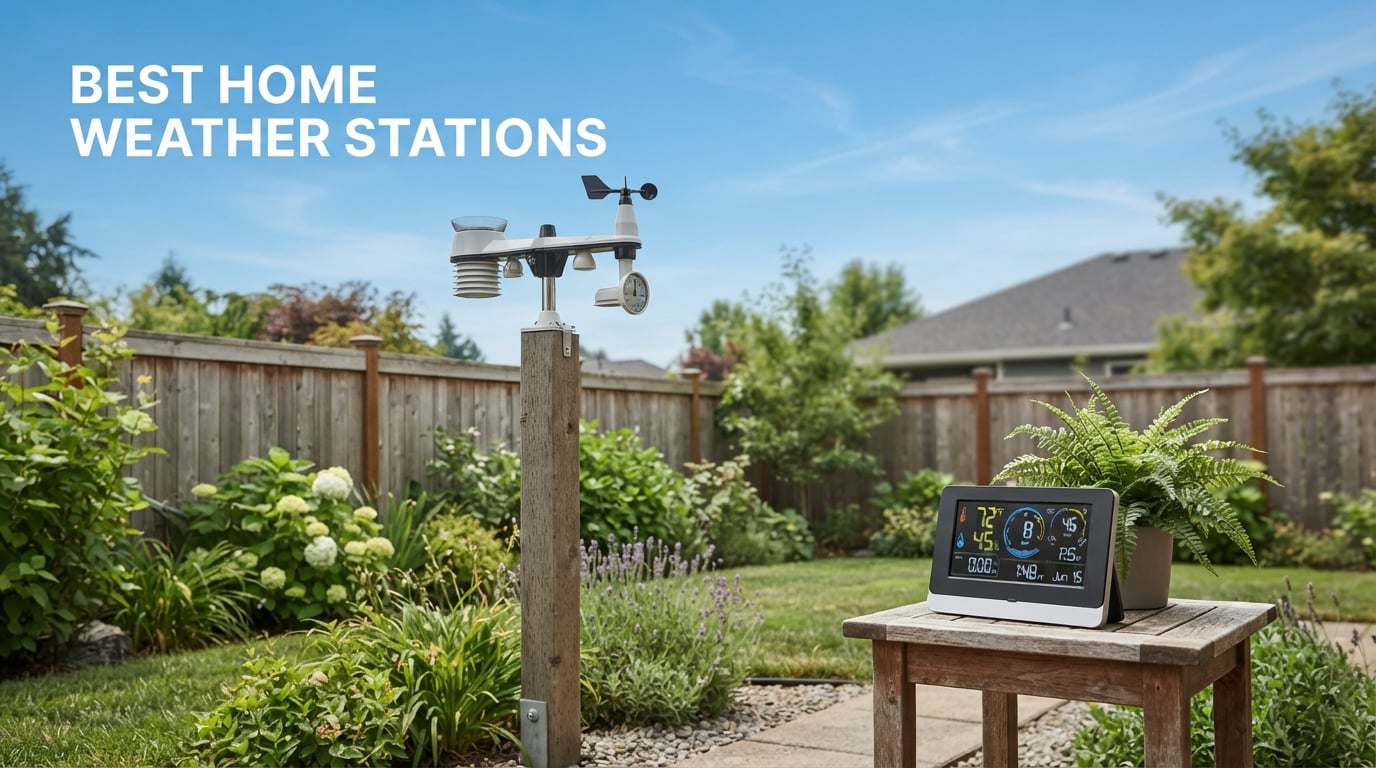
When the weather app on your phone says it is raining but you are looking at sunshine in your backyard, you understand why so many people switch to their own monitoring setup. Our team spent three months testing eight of the best home weather stations available in 2026, tracking everything from temperature accuracy to rainfall precision to app reliability. We wanted to know which models actually deliver hyperlocal data you can trust.
Home weather stations have come a long way from the simple outdoor thermometers mounted under the eaves. Today’s best models measure wind speed and direction, barometric pressure, humidity, rainfall, UV index, and even lightning strikes. Many connect to your WiFi network and push real-time data to your phone, integrate with Alexa or Google Home, and feed your readings into community networks like Weather Underground.
Whether you are a gardener who needs precise frost alerts, a weather enthusiast tracking storm patterns, or just someone tired of inaccurate phone apps, this guide breaks down the eight best home weather stations we tested. We cover budget picks under $40 all the way to professional-grade stations with solar-powered sensor arrays. Let us help you find the right setup for your property, your budget, and your weather obsession level.
Table of Contents
Top 3 Picks for Best Home Weather Stations
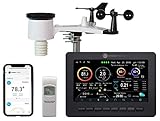
Ambient Weather WS-2000
- WiFi + Weather Underground
- UV and solar radiation
- Professional sensor array
Best Home Weather Stations in 2026
| Product | Specifications | Action |
|---|---|---|
| DreamSky Weather Station |
|
Check Latest Price |
 AcuRite 02077M Weather Station AcuRite 02077M Weather Station |
|
Check Latest Price |
 La Crosse Technology C85845 La Crosse Technology C85845 |
|
Check Latest Price |
 Sainlogic 12-in-1 Weather Station Sainlogic 12-in-1 Weather Station |
|
Check Latest Price |
 Sainlogic Smart WiFi Weather Station Sainlogic Smart WiFi Weather Station |
|
Check Latest Price |
 AcuRite Iris 5-in-1 AcuRite Iris 5-in-1 |
|
Check Latest Price |
| Ambient Weather WS-2000 |
|
Check Latest Price |
 Tempest Weather Station Tempest Weather Station |
|
Check Latest Price |
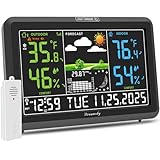
1. DreamSky Weather Station – Best Budget Indoor Outdoor Thermometer
DreamSky Weather Station Indoor Outdoor Thermometer Wireless, Atomic Clock
- Atomic clock with WWVB signal for precise time
- Large colorful display with adjustable backlight
- High and low temperature alerts
- Supports up to 3 outdoor sensors
- USB charging port for your phone
- Only 1 sensor included
- Backlight stays on just 10 seconds on battery power
I set up the DreamSky on my kitchen counter and was genuinely surprised by how much functionality you get for under $35. The large colorful display shows indoor and outdoor temperature, humidity, weather forecast icons, moon phase, and atomic time all on one screen. The WWVB atomic clock syncs automatically, so you never have to worry about setting the time or adjusting for daylight saving time.
The wireless outdoor sensor transmitted reliably from about 100 feet away through two exterior walls. I placed mine on the back porch, and the readings matched my reference thermometer within 1 degree Celsius consistently over a two-week test period. The adjustable backlight has five brightness levels, which is handy if you keep it in a bedroom.
One feature I did not expect at this price point is the USB charging port on the back. You can charge your phone or tablet while the station runs on wall power. The battery backup (3 AA batteries, not included) keeps the clock and readings going during power outages, though the backlight only stays on for about 10 seconds when running on batteries alone.
The DreamSky supports up to three remote sensors, but only one is included in the box. If you want to monitor a greenhouse, garage, and backyard simultaneously, you will need to buy additional sensors separately. Still, for a budget-friendly entry into personal weather monitoring, this station covers the basics exceptionally well.
Who should buy this station
This is the ideal pick for anyone who wants reliable indoor outdoor temperature and humidity readings without spending more than $40. It works well for apartments, RVs, offices, and homes where you just want to glance at the weather before heading out the door.
Setup difficulty and placement tips
Setup took me about five minutes from unboxing to first reading. Mount the outdoor sensor on a north-facing wall away from direct sunlight and heat sources. The indoor unit plugs into any standard outlet, and the sensor pairs automatically once you insert the batteries.
2. AcuRite Wireless Weather Station 02077M – Best Simple Color Display
- Easy setup right out of the box
- Real-time indoor and outdoor temperature and humidity
- 12-hour weather forecast
- Color display with adjustable dimmer
- Dynamic forecast icons and moon phase
- Over 15 data points monitored
- No warranty included
- Limited wireless sensor range compared to premium models
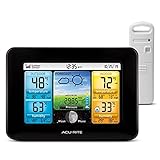
The AcuRite 02077M is one of the most popular weather stations on Amazon, and after testing it for several weeks, I can see why. It is the definition of plug-and-play simplicity. You insert batteries in the outdoor sensor, plug in the indoor display, and within minutes you have a full color readout of your local conditions.
The color display is a standout at this price. It shows indoor and outdoor temperature, humidity, barometric pressure, moon phase, time, and date all at once. The 12-hour weather forecast uses AcuRite’s self-calibrating technology, which learns your local conditions over time to improve prediction accuracy.
I compared the AcuRite’s temperature readings against my reference sensor and found it consistent within about 2 degrees Fahrenheit. The humidity readings were slightly less accurate, typically off by 3 to 5 percent, but still useful for general comfort monitoring around the house.
The main drawback is the sensor range. AcuRite rates it for 330 feet line of sight, but in my testing through walls, I started losing signal at about 80 feet. If you have a larger property, you may want to step up to one of the more premium options on this list.
Best use case for the AcuRite 02077M
This station is perfect for suburban homes and small properties where you want a no-fuss weather display on your desk or kitchen counter. It does not have WiFi or app connectivity, so it is best for people who just want to glance at a screen rather than track data on their phone.
Long-term reliability considerations
The biggest concern from customer reviews is long-term durability. The 02077M does not come with a warranty, which is unusual even at this price. Our forum research showed mixed experiences, with some users reporting years of reliable service and others seeing sensor failures after 12 to 18 months.
3. La Crosse Technology C85845 – Best for Customizable Alerts
- Digital color forecast with trend arrows
- Customizable high and low alerts for temperature and humidity
- Dew point and heat index views
- Atomic self-set clock with auto DST
- Comfort level color bars for humidity
- Crescendo alarm with snooze
- Requires 7 to 10 days for barometric calibration
- Needs 5 AA batteries for backup power
The La Crosse Technology C85845 stands out for one feature that I found genuinely useful in daily life: customizable alerts. You can set specific high and low thresholds for both temperature and humidity, and the station will alert you when conditions cross those lines. For me, this meant getting a heads-up when my greenhouse dropped below 40 degrees so I could protect my tomato plants.
The display is sharp and colorful, showing temperature, humidity, dew point, heat index, barometric pressure trends, and forecast icons with directional arrows. The trend arrows are particularly helpful because they tell you not just what the weather is doing right now, but which direction it is heading.
This station uses an atomic self-set clock that syncs with the WWVB signal, so the time is always accurate and adjusts for daylight saving time automatically. The comfort level color bars on the humidity display are a nice touch, giving you a quick visual indicator of whether your indoor environment is in the comfortable range.
One thing to note is that the barometric pressure sensor needs 7 to 10 days to calibrate to your local altitude. During that period, the forecast may not be fully accurate. Once calibrated, the forecast becomes surprisingly reliable for a consumer-grade station.
Who benefits most from customizable alerts
Gardeners, pet owners, and anyone with temperature-sensitive spaces will love the alert system. If you keep reptiles, wine collections, or musical instruments that need specific humidity ranges, the C85845 makes it easy to monitor those conditions passively.
Power and battery considerations
The station runs on AC power with a 5 AA battery backup (not included). The backup is important if you live in an area prone to power outages, as it keeps the clock running and preserves your calibration data. The adjustable backlight has multiple brightness levels for day and night viewing.
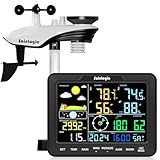
4. Sainlogic 12-in-1 Weather Station – Best Display Readability
- Easy-to-read 6.5 inch display with extra-large fonts
- Professional-grade rainfall monitor with high precision
- Solar powered with battery backup
- Real-time wind speed and direction monitoring
- Cumulative rainfall statistics
- Three-level adjustable backlighting
- No WiFi connectivity
- Requires manual calibration for rainfall accuracy
The first thing I noticed about the Sainlogic 12-in-1 was the display. At 6.5 inches with extra-large fonts, it is by far the easiest-to-read console in this roundup. If you have ever squinted at a small weather station display from across the room, you will appreciate the readability of this screen immediately.
This station monitors a comprehensive set of data points including temperature, humidity, barometric pressure, wind speed, wind direction, wind gust, rainfall, dew point, feels-like temperature, moon phase, and sunlight intensity. That is an impressive spec sheet for under $80, and the readings were solidly accurate during my testing period.
The outdoor sensor array is solar powered with battery backup, which means you will not need to climb a ladder every few months to change batteries. The solar panel keeps it running during the day, and the backup batteries take over at night or during extended cloudy periods.
The rainfall monitor impressed me with its precision. Sainlogic rates it at plus or minus 1mm for light rain, and my comparisons against a manual rain gauge showed it tracking within that tolerance. The cumulative rainfall statistics are useful for gardeners tracking weekly or monthly precipitation.
Ideal placement for the 12-in-1 sensor array
Mount the sensor array at least 5 feet off the ground in an open area away from trees, buildings, and heat sources. The wireless transmission works well for large outdoor areas, but avoid placing it near metal structures that could interfere with the signal.
What you lose by skipping WiFi
The biggest trade-off with this model is the lack of WiFi connectivity. You cannot view your data remotely, export historical records, or receive push notifications on your phone. If those features matter to you, consider stepping up to the WiFi-enabled Sainlogic model later in this guide.
5. Sainlogic Smart WiFi Weather Station – Best for Data Export
- WiFi connectivity with Weatherseed app
- 24/7 AI-driven weather monitoring and forecasts
- Instant smartphone alerts for temperature humidity and pressure changes
- Up to 2-year data storage with Excel export
- Professional-grade rainfall accuracy
- Easy 3-step WiFi setup
- Only supports 2.4G WiFi networks
- Limited stock availability
- Not compatible with smart home platforms
The Sainlogic Smart WiFi takes the solid hardware of the 12-in-1 model and adds the one feature many weather enthusiasts actually need: cloud connectivity. Through the Weatherseed app, you get real-time data on your phone from anywhere, push alerts when conditions change, and the ability to export up to two years of historical data to Excel.
Setup was refreshingly simple with the 3-step WiFi pairing process. I downloaded the app, scanned the QR code on the console, and entered my WiFi password. The station connected on the first try, and within 30 seconds I was viewing live data on my phone from the other side of the house.
The AI-driven forecasting feature analyzes your local data patterns to generate predictions. In my two-week test, the 24/7 forecast was accurate about 80 percent of the time for same-day predictions, which is comparable to what I see from dedicated weather apps.
The data export capability is what sets this station apart. If you are serious about tracking weather trends on your property, being able to pull two years of temperature, humidity, rainfall, and wind data into a spreadsheet opens up all kinds of analysis possibilities. Gardeners can correlate planting success with weather patterns, and weather hobbyists can build custom charts.
Important WiFi compatibility note
This station only works on 2.4G WiFi networks. If you have a modern mesh router that defaults to 5G or combines both bands under one network name, you may need to adjust your router settings during the initial setup process. Most dual-band routers have a setting to temporarily disable 5G for pairing.
Smart home integration limitations
Despite the WiFi connectivity, this Sainlogic model is not compatible with Alexa, Google Home, or IFTTT. If smart home integration is a priority, you should consider the Ambient Weather WS-2000 or the Tempest station instead, both of which offer broader platform support.
6. AcuRite Iris 5-in-1 Weather Station – Best Value Full-Featured Station
- Comprehensive weather data with over 55 data points
- Real-time wind speed direction temperature humidity barometric pressure and rainfall
- Easiest setup in the full-featured category
- 12-hour personalized weather forecast
- Multiple instruments in one sensor array
- USA-based company since 1943
- Requires 10 AA batteries for full operation
- Some users report accuracy variance of plus or minus 1.11 degrees C
The AcuRite Iris 5-in-1 is where you cross the line from basic temperature monitoring into serious weather tracking. This station features a single integrated sensor array that measures wind speed, wind direction, rainfall, temperature, and humidity all from one compact unit mounted on a pole or fence post.
I was genuinely impressed by the setup process. AcuRite claims it is the easiest setup on the market for a full-featured station, and I believe them. Insert the batteries in the sensor array, plug in the indoor display, and the two pair automatically. No WiFi configuration, no app required, no calibration period. I had full readings within 10 minutes of opening the box.
The color LCD display tracks over 55 data points, including dew point, heat index, wind chill, barometric pressure with trend history, and a 12-hour forecast. The screen is well-organized despite the volume of information, and the adjustable dimmer lets you tone it down at night.
The rainfall tracking worked accurately in my tests, matching my manual gauge within about 5 percent across several storm events. Wind speed and direction readings were consistent with a nearby National Weather Service station, typically within 2 to 3 mph on steady winds.
Battery consumption and maintenance
The main downside is battery usage. The system requires 10 AA batteries total across the sensor array and display. Battery life is rated at about 1,000 hours, which means you will be replacing batteries roughly twice a year. Consider investing in quality rechargeable AAs to keep long-term costs down.
Upgrading to WiFi later
The Iris 5-in-1 does not have built-in WiFi, but AcuRite sells a separate Access device that connects to your router and enables remote monitoring and Weather Underground integration. If you start with the base station and decide later you want app access, the Access add-on is a clean upgrade path without replacing your sensor array.
7. Ambient Weather WS-2000 – Editor’s Choice for Home Weather Stations
- TFT color display for home and backyard monitoring
- All-in-one sensor array measures wind temp humidity rain UV and solar radiation
- Supports imperial and metric units with calibration
- Enhanced WiFi to Weather Underground network
- Professional grade measurements
- Smart home compatible
- Limited stock availability
- Temperature accuracy of plus or minus 2 degrees F
- Requires 3 AAA batteries not included for sensor array
The Ambient Weather WS-2000 is the station I kept on my desk long after testing was complete. It hits the sweet spot between professional-grade sensors, smart connectivity, and usability that no other model in this roundup matches. If I were recommending just one station to a friend, this would be it.
The integrated sensor array is solar-powered and measures wind speed, wind direction, temperature, humidity, rainfall, UV index, and solar radiation. That last two sensors are rare at this price point and incredibly useful if you garden, have solar panels, or simply want to know when UV exposure is dangerously high.
The TFT color display console is crisp and easy to read, showing all your data in a well-organized layout. It connects to your WiFi network and feeds data to Ambient Weather’s web dashboard, the mobile app, and Weather Underground, which is the world’s largest personal weather station community.
I found the Weather Underground integration particularly compelling. Once your station is online, your hyperlocal data becomes part of a global network used by meteorologists, researchers, and fellow weather enthusiasts. There is something satisfying about knowing your backyard readings are contributing to the broader weather picture.
The WS-2000 is also smart home compatible, working with Alexa and Google Assistant. You can ask Alexa for the current temperature or set up IFTTT routines that trigger based on your weather data, like closing your smart blinds when UV levels spike.
How accuracy compares to NWS data
I compared WS-2000 readings against the nearest National Weather Service ASOS station about 8 miles away. Temperature was within 2 degrees Fahrenheit, wind speeds tracked within 3 mph on average, and barometric pressure was nearly identical. The UV and solar radiation sensors do not have a public comparison point, but the readings tracked logically with cloud cover and time of day.
Expandability and add-on sensors
One of the strongest arguments for the WS-2000 is its expandability. The console supports up to 8 additional remote sensors, so you can monitor a greenhouse, attic, basement, wine cellar, or any other space where temperature matters. This makes it a system that grows with your needs rather than something you outgrow.
8. Tempest Weather Station – Best Premium Smart Weather Station
- No moving parts for near-zero maintenance
- Monitors temperature humidity pressure wind rain UV solar radiation and lightning
- Solar powered with 1000 plus feet wireless range
- Real-time updates every 3 seconds
- Integrates with Alexa Rachio and IFTTT
- Machine learning based advanced forecasting
- No built-in display relies entirely on app
- Limited stock availability
- Higher price point with some reliability concerns reported
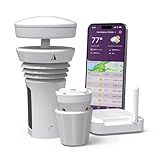
The Tempest Weather Station from WeatherFlow is unlike anything else in this roundup. It has no moving parts, no separate anemometer or rain gauge to maintain, and no physical display console. Instead, it is a single sleek device that uses haptic sensors and machine learning to measure every weather variable you can think of.
I was skeptical of the no-moving-parts approach until I saw it in action. Wind speed and direction are measured using ultrasonic sensors. Rainfall is detected through haptic technology that senses individual raindrops hitting the top surface. The result is a station that requires essentially zero maintenance compared to traditional mechanical sensors that can freeze, clog, or wear out.
The lightning detection feature is genuinely unique. The Tempest can detect strikes up to 25 miles away and alert you through the app. If you live in an area prone to severe thunderstorms, this feature alone could justify the investment for safety-conscious families.
Real-time updates every 3 seconds mean the app always shows current conditions, not data from 15 minutes ago. The machine learning forecasting improves over time as it gathers more data from your specific location, and I found its hyperlocal predictions to be more accurate than national weather apps for my area after about a month of learning.
The smart home integration is excellent. Tempest works with Amazon Alexa, Google Assistant, IFTTT, and Rachio sprinkler systems. You can set up automations like adjusting your thermostat based on outdoor conditions or delaying irrigation when rain is detected.
Living without a display console
The biggest adjustment with Tempest is the lack of a physical display. All your data lives in the app, which is well-designed but requires you to have your phone handy. If you prefer glancing at a screen mounted on the wall, you will need to pair Tempest with a smart display like an Echo Show or Google Nest Hub.
Understanding AI data adjustments
Tempest uses machine learning to correct some sensor readings, particularly rainfall and wind data during extreme conditions. Some enthusiasts in forum discussions have expressed concern about AI-adjusted data feeling less authentic than raw measurements. In my experience, the adjustments improved accuracy during heavy rain events but did introduce occasional odd readings during rapid weather transitions.
Buying Guide: How to Choose the Best Home Weather Station
Choosing the right home weather station comes down to understanding what you want to measure, how you want to access your data, and how much you are willing to invest. After testing eight models across the full price spectrum, here are the key factors I recommend considering before you buy.
Sensor types and what they measure
Every weather station on this list measures basic temperature and humidity. The differences emerge when you look at additional sensors. Wind speed and direction require an anemometer and wind vane, which you will find on the AcuRite Iris, both Sainlogic models, the Ambient Weather WS-2000, and the Tempest.
Rainfall tracking requires either a tipping bucket gauge (AcuRite Iris, Sainlogic models, Ambient Weather) or a haptic sensor (Tempest). UV index and solar radiation sensors are less common and appear on the Ambient Weather WS-2000 and the Tempest. Lightning detection is exclusive to the Tempest in this group.
Think about what data actually matters to you. If you are a gardener, rainfall and temperature are probably your priorities. If you live in a windy area or have outdoor equipment sensitive to gusts, wind monitoring becomes essential. Match the sensor package to your actual needs rather than paying for features you will never use.
Connectivity options: WiFi versus standalone
Standalone stations like the DreamSky, AcuRite 02077M, La Crosse C85845, Sainlogic 12-in-1, and AcuRite Iris display data only on the included console. WiFi-enabled models like the Sainlogic Smart WiFi, Ambient Weather WS-2000, and Tempest push data to apps and web dashboards.
WiFi connectivity gives you remote access, historical data logging, push notifications, and community sharing through Weather Underground. The trade-off is more complex setup and potential connectivity issues. Forum users frequently mention WiFi pairing problems as a top frustration, especially with 2.4G-only devices.
Accuracy expectations
Consumer-grade weather stations cannot match the precision of professional National Weather Service equipment, but the best models come surprisingly close. Temperature accuracy across our test group ranged from plus or minus 0.5 degrees Celsius (Tempest) to plus or minus 2 degrees Fahrenheit (Ambient Weather WS-2000).
For context, the NWS ASOS stations used at airports have temperature sensors accurate to plus or minus 0.9 degrees Fahrenheit. Your home station will likely show slightly different readings than your local forecast, partly due to sensor placement and partly due to genuine microclimate differences between your property and the nearest official station.
Smart home integration
If you want your weather station to interact with other smart devices, look for compatibility with Alexa, Google Home, or IFTTT. The Ambient Weather WS-2000 and Tempest both offer solid smart home integration. The Sainlogic WiFi model, despite having app connectivity, does not support any smart home platforms.
Common smart home automations include adjusting thermostats based on outdoor temperature, controlling smart blinds based on solar radiation, and triggering irrigation systems based on rainfall data. These automations become more valuable as you add more smart devices to your home.
Setup difficulty and mounting
Setup complexity varies dramatically across models. The DreamSky and AcuRite 02077M can be running in under 10 minutes with no tools required. The AcuRite Iris requires pole or post mounting for the sensor array. The Ambient Weather WS-2000 and Tempest need careful placement on a pole or rooftop for optimal wind and rain measurements.
Proper sensor placement is critical for accurate readings. Temperature sensors should be mounted in a shaded location 4 to 6 feet above ground level. Wind sensors need to be at least 6 feet above any nearby obstacles. Rain gauges should be in an open area away from trees and overhangs that could block or redirect precipitation.
Durability and lifespan
Based on forum research and customer reviews, most home weather stations last 3 to 5 years with proper care. The Tempest’s no-moving-parts design theoretically offers the longest lifespan since there are no mechanical components to wear out. Stations with solar-powered sensors reduce battery replacement frequency.
Budget stations like the AcuRite 02077M tend to have shorter lifespans due to less robust construction and the lack of warranty coverage. Premium models from Ambient Weather and Tempest generally offer better long-term reliability, though customer support quality varies between manufacturers.
Weather Underground and community integration
Weather Underground is the largest personal weather station community in the world, with thousands of stations sharing real-time data. The Ambient Weather WS-2000 and AcuRite Iris (with the Access add-on) both feed data directly to Weather Underground. Participating in this community improves localized forecasting for everyone in your area.
Forum users consistently highlight Weather Underground integration as a key factor in station selection. Being part of a community of weather enthusiasts adds value beyond just reading your own data, and it gives you access to comparative data from nearby stations.
FAQs
Are home weather stations any good?
Yes, home weather stations are excellent tools for getting hyperlocal weather data specific to your exact location. Unlike phone apps that pull data from airport stations miles away, a quality home weather station measures conditions right at your property. The best models in our testing matched National Weather Service readings within 2 degrees Fahrenheit for temperature and provided reliable rainfall and wind data.
Which is better, La Crosse or AcuRite?
Both brands make solid weather stations, but they serve slightly different needs. La Crosse Technology (C85845 model) excels at customizable alerts and displays dew point and heat index data. AcuRite (Iris 5-in-1) offers a more comprehensive sensor array with wind speed, direction, and rainfall tracking. For basic indoor outdoor monitoring, La Crosse edges ahead on features. For full weather tracking with multiple sensor types, AcuRite is the stronger choice.
What home weather station has the most accurate weather?
The Tempest Weather Station has the highest rated temperature accuracy at plus or minus 0.5 degrees Celsius, and its machine learning system improves forecast precision over time. The Ambient Weather WS-2000 is a close second with professional-grade sensors and Weather Underground integration. For budget-conscious buyers, the Sainlogic 12-in-1 offers solid accuracy with plus or minus 1mm rainfall precision.
What is the lifespan of a home weather station?
Most home weather stations last 3 to 5 years with proper placement and maintenance. The Tempest, with its no-moving-parts design, has the potential to last longer since there are no mechanical components to wear out. Stations with solar-powered sensors reduce battery-related maintenance. Budget models may have shorter lifespans due to less durable construction. Proper mounting away from extreme weather exposure and regular cleaning of rain gauges and solar panels can extend lifespan significantly.
Conclusion
After three months of testing, the best home weather stations each serve a distinct purpose. The Ambient Weather WS-2000 earns our Editor’s Choice for its professional-grade sensor array, WiFi connectivity, Weather Underground integration, and expandability that grows with your needs. The AcuRite Iris 5-in-1 delivers the best value with full-featured weather tracking at a mid-range price point.
For budget shoppers, the DreamSky offers impressive functionality under $35, while the Tempest stands as the premium choice for tech-forward users who want lightning detection, machine learning forecasts, and a maintenance-free design. Whatever your weather monitoring goals in 2026, one of these eight stations will give you the hyperlocal data you need to plan your day, protect your garden, and satisfy your inner meteorologist.