
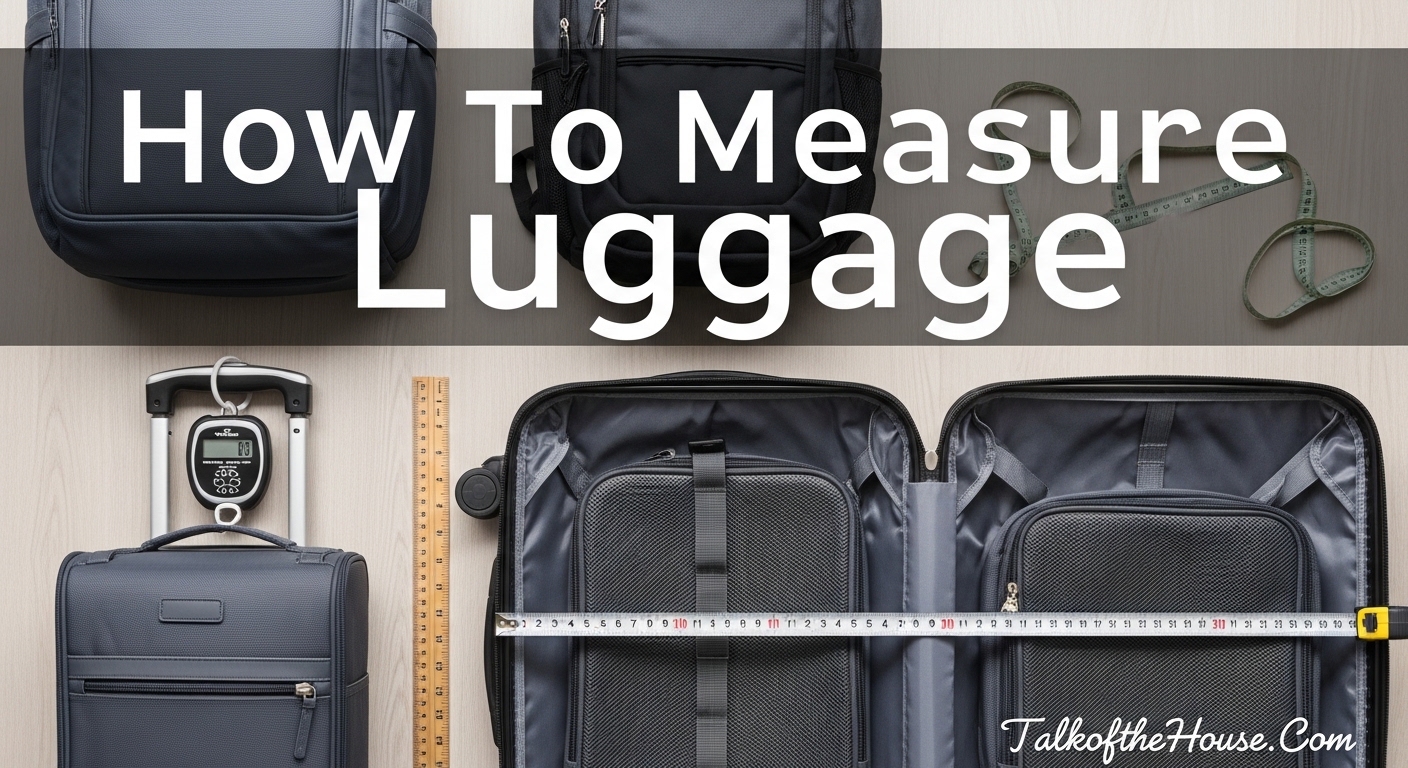
Whether you are planning a weekend getaway or preparing for an international trip, knowing how to measure luggage correctly can save you from unexpected baggage fees that range from $50 to $200. We have all heard stories about travelers at the gate whose bags are deemed too large, forcing them to pay hefty fees or rearrange their belongings. This guide will walk you through exactly how to measure luggage so you can avoid those stressful surprises.
Getting accurate luggage measurements is essential because airlines have strict size limits that vary between carriers and ticket classes. A bag that fits perfectly on one airline might incur extra charges on another. By learning to measure your own bags, you gain control over your travel budget and can pack with confidence knowing your luggage meets the requirements.
Table of Contents
What You Need Before You Start
Before you begin measuring, gather a few simple items. You do not need anything fancy, but having the right tools makes the process much easier.
A flexible measuring tape works best for luggage because you can easily wrap it around curved surfaces and corners. If you only have a rigid ruler, you can still measure, but you will need to be more careful about positioning. Have a notepad or your phone ready to record each measurement. That is all you need to get started.
How To Measure Luggage in 8 Steps
Follow these eight straightforward steps to get accurate luggage measurements every time. We recommend doing this before every trip, especially if you are using a new bag or flying a different airline.
Step 1: Place your suitcase upright on a flat surface such as a hardwood floor or tile. Make sure the bag is standing straight, not leaning.
Step 2: Measure the height from the floor to the top of the bag. This is crucial: include the wheels at the bottom and the extended handle at the top in your measurement. Many travelers forget these parts and end up with incorrect numbers.
Step 3: Measure the width at the widest point of the bag, which is typically the front or back panel. Most suitcases are wider than they are deep, so this measurement is usually larger.
Step 4: Measure the depth from the deepest point, usually the front of the bag to the back panel. Do not press in on softside bags; measure at the widest protrusion.
Step 5: Record all three measurements in inches on your notepad. Write them down clearly so you do not forget or mix them up later.
Step 6: If you need centimeters, convert using the simple formula: 1 inch equals 2.54 centimeters. Many international airlines list their requirements in both inches and centimeters.
Step 7: Add your height, width, and depth measurements together. This sum is your total linear inches. Airlines use this number to determine if your bag meets their size requirements.
Step 8: Compare your total to your specific airline limits. Keep in mind that different airlines have different maximums, and these can even vary between ticket classes on the same airline.
Understanding Linear Dimensions
Linear dimensions simply mean the total of all three measurements added together. Most airlines set a maximum limit for checked luggage at 62 linear inches, which includes the height, width, and depth combined.
For carry-on luggage, the typical limit is 45 linear inches, though some budget carriers set theirs as low as 40 inches. These numbers represent the sum of all three dimensions, not any single measurement of the bag.
Understanding linear inches matters because it helps you quickly check if your bag qualifies without memorizing complex dimension charts. When you see a bag advertised as “62-inch linear,” it means the sum of its dimensions equals approximately 62 inches.
Do Not Forget Wheels and Handles
This is where most travelers go wrong. The most common mistake when measuring luggage is forgetting to include the wheels and handles in your measurements. Airlines measure the entire bag, including these protruding parts.
When measuring height, start from the floor including the wheels and measure all the way to the top of the extended handle. When measuring width and depth, include any external pockets or protrusions that add to the overall dimensions.
According to real traveler experiences shared in forums, even being half an inch over can sometimes trigger additional fees or gate checks. Our team has seen bags that appeared to be the right size get flagged because the wheels or handles were not accounted for in the original measurement.
Carry-On vs Checked vs Personal Item
Understanding the difference between bag types helps you choose the right luggage and avoid mishaps at the airport. Here is a quick breakdown of what each category typically means.
- Personal Item: This is the smallest category, usually limited to around 18 x 14 x 8 inches. Personal items must fit under the seat in front of you. This includes small backpacks, laptop bags, and totes.
- Carry-On: The standard carry-on size is 22 x 14 x 9 inches, which fits in the overhead bin. This is the most common luggage size for weekend trips and short business travels.
- Checked Luggage: Bags can be up to 62 linear inches combined, which translates to roughly 30 inches in height for a standard rectangular bag. Checked bags are essential for longer trips where you need more clothing and items.
Always check your specific airline because limits vary. Budget airlines typically have stricter limits and higher fees for oversized bags.
Should You Measure Packed or Empty?
This is a question our team gets often, and the answer depends on your packing style. For the most accurate measurement for airline purposes, measure your bag when it is empty or only partially packed.
Airlines measure your bag at check-in and at the gate, and they are measuring the external dimensions regardless of contents. However, if you have an expandable bag that zips open to add extra space, keep in mind that these additions count toward your total dimensions.
We recommend measuring your empty bag first to establish a baseline. Then, when you pack for your trip, do a quick check to see if your packed bag still fits within the limits. Softside bags can compress slightly during packing, which might help you squeak by if you are close to a limit.
Softside vs Hardside Luggage
Both softside and hardside luggage are measured the same way, but there are some differences worth noting. Hardside bags maintain their exact shape, so your measurements will be precise and consistent every time.
Softside bags can have slight variations depending on how full they are and where you measure. The fabric can bulge or compress, affecting your width and depth readings. When measuring a softside bag, take multiple measurements at different points and use the largest numbers.
Despite these differences, the measurement process remains identical for both types. Always include wheels and handles regardless of whether you have a softside or hardside suitcase.
Airline-Specific Size Limits
One of the biggest pain points shared by travelers is the inconsistency between airline size limits. While most US airlines follow similar guidelines, there are important variations to know.
Major carriers like Delta, American, and United typically allow checked bags up to 62 linear inches. However, budget carriers such as Spirit and Frontier have stricter limits and significantly higher fees for bags that exceed standard sizes.
International airlines may use the metric system, listing limits as 158 centimeters for checked luggage or 115 centimeters for carry-on. These are roughly equivalent to 62 and 45 linear inches respectively.
Always check your specific airline on their website or app before packing. Rules can change, and what worked last year might not apply to your upcoming trip.
Common Measurement Mistakes to Avoid
Learning from the mistakes others have made can save you time, money, and stress. Here are the most frequent errors we see and how to avoid them.
First, do not measure only the bag body without including wheels and handles. This is the single biggest mistake and leads to unexpected fees at the counter.
Second, do not assume all airlines use the same limits. Even within the same country, size restrictions can vary by 10% or more between carriers.
Third, if you have an expandable bag, remember that the expanded dimensions still count toward your total. Zipping open that extra compartment does not give you more allowance.
Fourth, when measuring depth, do not press in on soft bags to make them thinner. Measure at the widest point as airlines will do the same.
DIY Measurement Tips Without a Tape Measure
What if you do not have a measuring tape available? Our team has a few tricks you can use in a pinch.
Use a piece of string to wrap around each dimension, then hold it against a ruler or measuring stick to get your number. This works well and takes just a few extra minutes.
A standard credit card measures 3.375 x 2.125 inches, which can serve as a reference point. Lay it along your bag to visualize measurements, though this method works better for estimating than exact precision.
You can also use your own height as a reference. Stand next to your luggage and compare. If you are 5 feet 8 inches tall and the bag comes up to your waist, you can estimate its height based on your proportions.
What To Do If Your Bag Is Slightly Over Limit
Sometimes despite your best efforts, your bag might be a little over the limit. If this happens, you have a few options to consider.
At home, you can try compressing softside bags by pushing down on the contents and re-zipping. For hardside bags, try redistributing items to reduce protrusion.
If you are at the airport and your bag is over, some airlines will let you wear heavy items like jackets or boots to reduce weight and slightly shrink your bag dimensions. This is not ideal but can work in emergencies.
As a last resort, you can pay the oversized bag fee. These typically range from $100 to $200 depending on the airline and route, which is better than leaving items behind.
Measuring Luggage for International Travel
International travel often requires converting between measurement systems, which adds another layer of complexity. Most countries use centimeters and kilograms instead of inches and pounds.
To convert linear inches to centimeters, simply multiply your total by 2.54. A 62-inch linear bag equals approximately 158 centimeters. Many airlines list both measurements, but when in doubt, do the conversion.
Weight limits also differ internationally. While US carriers focus primarily on dimensions, many international airlines enforce strict weight limits in addition to size restrictions. A bag might be within size limits but exceed weight requirements.
Our team recommends double-checking both dimensions and weight limits before international flights, especially when traveling to countries with different standard measurement systems.
FAQs
How do you measure luggage size?
To measure luggage size, place your bag upright and measure three dimensions: height (floor to top, including wheels and handle), width (widest point side to side), and depth (front to back). Add these three numbers together for total linear inches. This sum is what airlines compare against their size limits.
What does 32 inch luggage mean?
32 inch luggage refers to the height of the bag when standing upright, not the total linear dimensions. A 32-inch suitcase is considered large and typically exceeds carry-on limits for most airlines, which usually max out around 22 to 24 inches in height.
Is a 28 inch suitcase 62 inches?
Not necessarily. A 28-inch suitcase refers to its height only. Whether it equals 62 linear inches depends on the width and depth as well. For example, a 28H x 18W x 16D bag would measure 62 linear inches total (28 + 18 + 16 = 62).
Is 27 inch luggage medium or large?
A 27-inch suitcase is typically considered a large bag. Most luggage brands categorize 24-28 inches as large, while medium usually falls between 20-24 inches. However, always check the exact dimensions since sizing varies between manufacturers.
How to measure luggage in centimeters?
To measure in centimeters, use the same three-step process: measure height, width, and depth in centimeters, then add them together for total centimeters. For international travel, 158 cm is equivalent to about 62 linear inches. Most airlines list both measurements on their websites.
Final Thoughts on Measuring Luggage
Knowing how to measure luggage correctly is one of those travel skills that pays off every time you fly. The few minutes you spend measuring before your trip can save you $100 or more in unexpected baggage fees.
Always include wheels and handles in your measurements, double-check your specific airline requirements, and measure when empty for the baseline. If you are close to a limit, err on the side of caution since airlines do not round down.
Make measuring your bags a regular habit before every trip. Your wallet and your peace of mind will thank you at the airport.